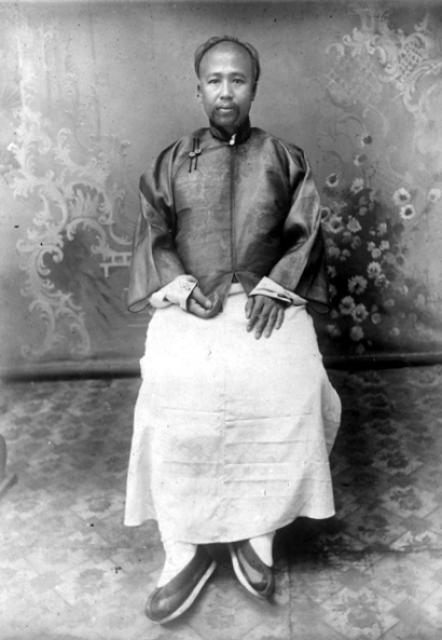
Kang Youwei
 China
ChinaBiography of Kan Yuvéi
Kan Yuvéi was a Chinese philosopher, reformer of the Qing Dynasty, and calligrapher. He led the movement for reforms in 1898 and advocated for constitutional monarchy, making him one of the first theorists of Chinese nationalism. His ideas formed the basis of the reformist movement supported by Emperor Guangxu. In 1917, he insisted on establishing a constitutional monarchy after the Xinhai Revolution, which overthrew the Qing Dynasty. Kan Yuvéi was born on March 19, 1858, in Nanhui County, Guangdong Province, into an aristocratic family that had produced 13 generations of scholars. His grandfather, Kan Zhanxu, achieved the rank of jinshi under Emperor Xianzong, while his father, Kan Dachu, served as the head of one of the counties in Jiangsu Province. From an early age, Kan began studying Confucian teachings and learned from the renowned expert on Neo-Confucianism, Zhu Zixi. In 1879, during a visit to Hong Kong, he discovered Western culture for the first time. In 1882, Kan went to Beijing to take the imperial examination, but he failed. On his way back home through Shanghai, he bought a large number of Western books and became influenced by Western evolutionary theories and political ideas. During this time, Kan became a proponent of fundamental reforms, although at that time, mass emigration of Chinese to Brazil seemed like an alternative to him. In 1888, Kan traveled to Beijing again to take the examination, which was administered by Emperor Guangxu himself. Kan expressed his belief in the need for reforms during the examination, but his pleas were not heard by the authorities. In 1895, Kan returned to the capital to take the examination again, but he failed. Finally, in late May of the same year, he passed the examination on his third attempt and received praise from the emperor. In July, together with Lian Qichao, Kan started publishing the unofficial reformist newspaper "Zhongwai Jingshi Bao". Later, the "Xianxuehui" (Society for Strengthening the State) was established. In 1897, Germany occupied Jiaozhou Bay, prompting Kan Yuvéi to once again appeal to the emperor to initiate reforms in the country. The emperor entrusted Kan with the detailed elaboration of his vision for reforms. In response, in January 1898, Kan developed a reform plan based on Japan's experience following the Meiji Restoration. In April 1898, Kan Yuvéi and Lian Qichao organized the "Bao Guo Hui" (Society for the Protection of the State). On June 16 of the same year, in the Summer Palace, the emperor received Kan Yuvéi and tasked him with developing a plan for reforming the state, which became known as the "Hundred Days' Reform". However, due to opposition from Empress Dowager Cixi, the reform movement suffered defeat. After the suppression of the reforms, Emperor Guangxu was placed under house arrest, and Kan Yuvéi's brother, Kan Guangzhen, was killed. With the help of a missionary named Timothy Richard, Kan managed to reach Shanghai, from where he departed for Hong Kong with the assistance of the personnel of the British consulate. From Hong Kong, Kan fled to Japan, where he declared himself a representative of the emperor and founded the "Baohuanhui" (Society for the Protection of the Emperor), aiming to carry out broad reforms within the framework of enlightened absolutism. In order to gain international support, Kan embarked on a trip to Europe (via the United States and Canada) and held meetings with European monarchs. He also attempted to establish an international party uniting Chinese immigrants from all over the world. Over the course of 16 years of exile, he visited 30 countries, including Mexico, Palestine, and Turkey, among others. He spent many years in Sweden, where he even bought a villa near the royal summer residence in Stockholm. After the Xinhai Revolution, Kan returned to his homeland and in 1913 began publishing the journal "Buzhen" (Enough Waiting). Becoming the leader of the monarchists, Kan vehemently opposed the republican system and demanded the return of Puyi to the imperial throne. In 1917, together with General Zhang Xun of the Northern Army, a loyal servant of the overthrown Qing Dynasty, he launched a campaign to restore imperial power. However, after some time, their forces were defeated by the army sent by Prime Minister Duan Qirui. In the following years, Kan consistently advocated for the return of Puyi to the throne and the establishment of a constitutional monarchy. After Puyi was expelled from the Forbidden City, the last emperor of China settled in Tianjin, where Kan visited him several times but categorically rejected the invitation to attend the wedding. Kan Yuvéi died in 1927 from food poisoning at a banquet held on the occasion of his 70th birthday. For some time after his death, his remains were located in Lixun Village near Mount Zhaoshan. In 1945, Kan was officially reburied in Qingdao, and in October of the following year, a ceremony was held at his tomb to install a memorial plaque. During the Cultural Revolution, Kan was regarded by Chinese historiography as the most ardent supporter of maintaining imperial power. His tomb was desecrated by the Red Guards, and his remains were scattered on the streets of the city. On December 27, 1985, Kan was reburied near Mount Fushan, where a monument in his honor was erected. The monument is currently protected by the state as a cultural heritage site. Kan Yuvéi's intellectual legacy is concentrated in his major work, "Da Tun Shu" (The Book of Great Unity). The title of the treatise refers to a utopian society described by Confucius and Xie Si, which existed in ancient times. There is debate about when the work was written: in his autobiography, Kan Yuvéi claimed that the treatise was written in 1884, but modern researchers, starting with Lian Qichao, have determined that the book was only completed in 1902, and the thinker continued to make amendments to it until his death. The first two chapters were published in the journal "Buzhen" in 1913, and in 1920, after the establishment of the League of Nations, Kan Yuvéi negotiated with F. Hirth about the publication of the complete text in English. The negotiations were not successful, and the book was published separately only in 1935, seven years after the author's death. The first modern edition was published in 1956 (301 pages, about 150,000 Chinese characters), and since then, the book has been reprinted several times. In 1958, an English translation by Lawrence Thompson was published. In contemporary China, the book is included in the lists of "100 Books That Have Influenced the Fate of Humanity." Mao Zedong pointed out that Kan Yuvéi presented a vivid image of future world communism. The book describes a society of the distant future, free from racial and national antagonisms, a society of gender equality, without state borders and governed by democracy. According to Kan Yuvéi, to gain international support, he undertakes a trip to Europe (via the United States and Canada) and holds meetings with European monarchs. He also tries to create an international party uniting Chinese immigrants from all parts of the world. In total, during 16 years of exile, he visits 30 countries, including Mexico, Palestine, Turkey, and others.