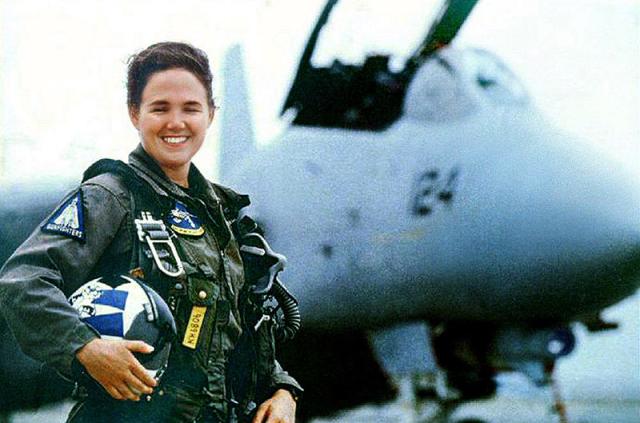
Kara Spears Hultgreen
 USA
USABiography of Kara Spears Hultgreen
Kara Spears Hultgreen was born in Greenwich, Connecticut. She spent her childhood in Chicago and Toronto, where her father moved for business. Her parents divorced in 1976, and in 1981, Hultgreen returned to the United States with her mother and settled in San Antonio.
After graduating from high school, Hultgreen unsuccessfully attempted to enter the Naval Academy. She later attended the University of Texas and completed the Aviation Officer Candidate School. After receiving her flight training, she was assigned to fly the EA-6A electronic warfare aircraft. However, her ultimate dream was to pilot a fighter aircraft.
In 1991, the U.S. Congress allowed women to participate in combat operations, but the implementation of this policy in the Navy began in 1993. In June 1993, Hultgreen began the training to fly the F-14 Tomcat, a carrier-based interceptor. After an initial failed attempt, she successfully qualified for carrier operations in July 1994, becoming the first female fighter pilot in the history of the U.S. Navy. She was assigned to the VF-213 Black Lions squadron aboard the aircraft carrier USS Abraham Lincoln. Her call sign was "Hulk," but it later changed to "Revlon" after she appeared on television with noticeable makeup, referencing the well-known cosmetics company.
On October 25, 1994, Lieutenant Hultgreen was conducting a routine training flight on an F-14A when the left engine experienced a compressor stall during the approach to the carrier. Hultgreen aborted the landing but lost control of the aircraft, causing it to crash into the water. The radar intercept officer, Lieutenant Matthew Klemish, initiated the ejection procedure for himself and the pilot. He successfully ejected, but Hultgreen's automatic ejection occurred slightly later, resulting in her death upon impact with the water. The U.S. Navy conducted a costly operation to recover Hultgreen's body and the wreckage from a depth of approximately 1100 meters (3600-3700 feet). Her body was recovered on November 12, and the aircraft was retrieved in December. Lieutenant Hultgreen was buried with military honors at Arlington National Cemetery.
In 1998, her mother, Sally Spears, published a book titled "Call Sign Revlon: The Life and Death of Navy Fighter Pilot Kara Hultgreen." Hultgreen gained recognition during her lifetime, and her death just three months after achieving her fighter pilot qualification ignited debates about women's inclusion in combat aviation. On February 28, 1995, the official investigation results were published, attributing the accident primarily to an engine failure. Vice Admiral Robert Span, the commander of naval aviation in the Pacific, stated that during the simulator reconstruction of the incident, eight out of nine male pilots also failed to handle a similar situation. However, an alternative theory blamed Hultgreen for the crash. In March 1995, an anonymous source within the Navy leaked an internal investigation report to the American media. The report suggested that Hultgreen's actions caused the engine compressor stall. Some F-14 pilots believed the accident could have been avoided if Hultgreen had followed the appropriate emergency procedures. Journalist Robert Caldwell, after conducting his own investigation, concluded that during the simulator reconstructions, the pilots were prohibited from executing those emergency procedures. There were speculations that the Navy rushed to assign female pilots to combat units without sufficient training to mitigate the fallout from a high-profile scandal that occurred at the Tailhook Association symposium in 1991, where many attending female pilots experienced sexual harassment (Hultgreen, who was also present at the symposium, confronted a male pilot's advances). Hultgreen's death was also connected to another controversy involving another female pilot aboard the USS Abraham Lincoln, Lieutenant Carey Lohrenz. In 1995, Lohrenz was grounded, possibly due to allegations of insufficient training for herself and Hultgreen, which were made by Elaine Donnelly, the director of the Center for Military Readiness. Lohrenz later sued the Navy, accusing them of sexism, and Donnelly, accusing her of defamation. The case was settled out of court, with Lohrenz receiving $150,000, and the lawsuit against Donnelly was dismissed.