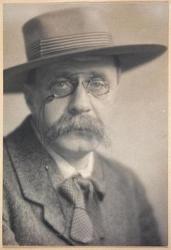
Karl Immermann
 Germany
- Early Life and Education
- Literary Beginnings
- Satire and Romanticism
- The Dusseldorf Theater
- Novels and Social Commentary
- Conservatism and Idealization
- The Confluence of Ideologies
Early Life and Education
Karl Lebrecht Immermann was born in Magdeburg, Prussia, in 1796 to a civil servant family. He participated in the War of Liberation in 1813 and pursued legal studies before entering government service in 1817.
Literary Beginnings
Immermann's early literary works, including his poems ("Gedichte") and tragedies ("Cardenio und Celinde"), reflected the late Romantic style. However, he later transitioned to historical dramas, such as "Kaiser Friedrich der II" and the "Alexis" trilogy, highlighting the role of strong individuals as drivers of history.
Satire and Romanticism
Immermann's novella "Der Karneval und die Somnambule" satirized the Romantic fascination with somnambulism and mesmerism. He also parodied Romanticism and Gothicism in his comedies ("Tulifäntchen") and the fairy tale drama "Merlin."
The Dusseldorf Theater
In 1835, Immermann became the director of the prestigious theater in Dusseldorf, where he collaborated with renowned playwright Christian Dietrich Grabbe. He opened a branch of the theater in Elberfeld-Barmen, where he interacted with the circle of "Young Rhineland Romantics," including Ferdinand Freiligrath, Ferdinand Engels, and Karl Marx.
Novels and Social Commentary
During this period, Immermann produced his most notable novels, "Die Epigonen" and "Münchhausen." Both works explored the clash between feudalism and industrialism, with Immermann expressing sympathy for the declining aristocracy and disdain for the rising bourgeoisie. In "Die Epigonen," his masterpiece, he depicted the triumph of industrial capitalism as a threat to the idyllic rural life of the nobility.
Conservatism and Idealization
Immermann's writings reflected his conservative leanings. He admired the virtues of the peasantry and idealized traditional peasant lifestyles. His work foreshadowed the Romantic revival and the rise of conservative nationalism in Germany.
The Confluence of Ideologies
Immermann's unique perspective blended elements of upper-class nostalgia, popular conservatism, and a nascent sympathy for the working class. His literary contributions captured the social and ideological complexities of German society in the midst of political and economic transformations.