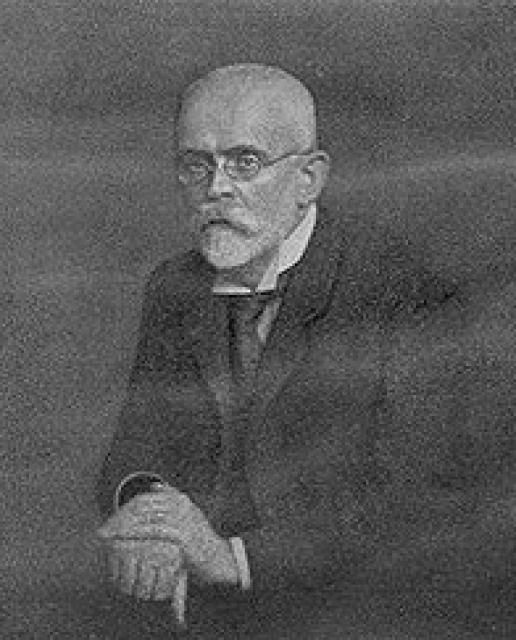
Karl Krumbacher
 Germany
- Karl Krumbacher: An Eminent Philologist and Byzantinist
- Academic Contributions
- Influence on Byzantine Studies
- Connections to Russia
- Cultural Advocacy
Karl Krumbacher: An Eminent Philologist and Byzantinist
Education and CareerKarl Krumbacher was born in Kempten, Germany, where he received his primary education at the Kempten Gymnasium. Subsequently, he pursued classical philology and Indo-European languages at the universities of Munich and Leipzig from 1876 to 1879. After teaching as a schoolteacher in Munich from 1879 to 1891, he obtained his doctorate in 1883 and habilitated in 1885 in medieval and modern Greek philology.
In 1892, Krumbacher became Professor of Medieval and Modern Greek Language and Literature at the University of Munich, a position he held until 1909. Notably, in 1896, he became the first professor of Byzantine studies at the University of Munich, a position created specifically for him. He was also an associate member of the Munich Academy from 1890.
Academic Contributions
Krumbacher's monumental work, "Geschichte der byzantinischen Literatur von Justinian bis zum Ende des Oströmischen Reiches, (527-1453)" ("History of Byzantine Literature from Justinian to the Fall of the Eastern Roman Empire"), published in 1891, remains a seminal text in the field. This comprehensive and detailed account of Byzantine sources and literature remains a foundational reference for Byzantine studies.
Furthermore, Krumbacher initiated several publishing projects, including the compilation of Greek acts and other primary sources. He also published on the history of the Greek language, Byzantine poetry, and hymnology, and authored specialized monographs on influential Byzantine writers such as Romanos the Melodist and Michael Glycas.
Influence on Byzantine Studies
Krumbacher's work had a profound impact on the development of Byzantine studies as a discipline. He challenged traditional views of Byzantium as stagnant and its literature as derivative, emphasizing the importance of Byzantine writings as expressions of their own time. His research also contributed to the recognition of Byzantium as a distinct and vibrant civilization.
Connections to Russia
Krumbacher had a deep appreciation for Russian and Slavic cultures. He mastered the Russian language and forged close connections with Russian scholars such as F.I. Uspensky, A.A. Vasiliev, and V.M. Istrin. He was elected a foreign corresponding member of the Imperial Saint Petersburg Academy of Sciences in 1894. His support for Russian scholars, including the publication of his work in Russian translation, fostered a collaborative relationship between German and Russian Byzantine studies.
Cultural Advocacy
In 1908, Krumbacher penned the programmatic article "Der Kulturwert des Slawischen und die slawische Philologie in Deutschland" ("The Cultural Value of Slavic Languages and Slavic Philology in Germany"). In this piece, he extolled the cultural significance of Slavic civilization and advocated for the inclusion of Slavic languages in the curricula of European universities. Krumbacher held Russian literature in particularly high esteem, regarding it as one of the foremost cultural languages of his time.


