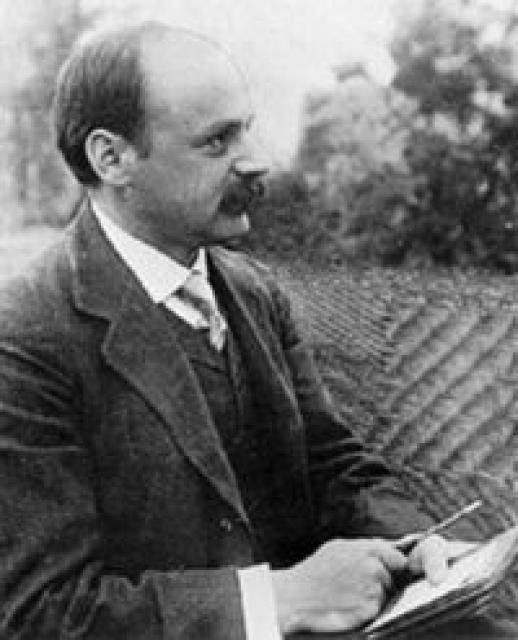
Karl Schwarzschild
 Germany
Biography of Karl Schwarzschild
Karl Schwarzschild, born on October 9, 1873 in Frankfurt-on-Main, Germany, was a German astronomer and one of the founders of theoretical astrophysics. He exhibited scientific abilities at a young age, publishing a paper on celestial mechanics at the age of 16.
In 1901, Schwarzschild became a professor and director of the observatory at the University of Göttingen. Later, from 1909 to 1916, he served as the director of the Potsdam Astrophysical Observatory. In 1912, he was elected a member of the Berlin Academy of Sciences and became a professor at the University of Berlin.
Schwarzschild made pioneering contributions to the theory of stellar atmospheres and the internal structure of stars. He conducted important research in the field of practical astrophysics, stellar dynamics, and the theory of relativity. He laid the foundations for precise photometry and developed various methods and instruments for accurately determining the brightness of stars from photographs. He empirically established the law linking darkening on a photographic plate with exposure time, known as Schwarzschild's law.
Between 1910 and 1912, Schwarzschild compiled an accurate catalog of the photographic magnitudes of 3500 stars, which served as the basis for statistical studies on estimating stellar temperatures and distances. He also established the zero point of the photographic magnitude scale, connecting it with the visual magnitude scale. In 1899, he discovered that changes in the brightness of variable stars, particularly Cepheids, were accompanied by changes in their effective temperature.
In 1907, Schwarzschild proposed the law of ellipsoidal distribution of stellar velocities in the galaxy to explain their observed systematic motions. His theory, an alternative to the "two-stream" theory by J.C. Kapteyn, was confirmed after the discovery of galactic rotation. Between 1910 and 1912, he formulated general integral equations of stellar statistics that linked absolute and apparent stellar characteristics with their spatial density, providing a complete solution to these equations.
In 1906, Schwarzschild introduced the concept of radiative equilibrium in stellar atmospheres, suggesting that energy transfer in the atmosphere primarily occurs through radiation rather than convection. He developed a mathematical theory of radiative equilibrium and a corresponding model of stellar atmosphere structure. He further developed Niels Bohr's theory of atomic spectra, independently deriving the basic principles of quantization and providing a complete theory of the Stark effect (the influence of electric fields on light). Schwarzschild also started to develop a quantum theory of molecular spectra.
In 1911, he explained the brightness distribution in the tail of Comet Halley using the mechanism of fluorescent emission from molecules. In 1916, Schwarzschild obtained the first exact solution to Albert Einstein's field equations of general relativity, expressing the general law of universal gravitation for a static spherically symmetric case. He studied the motion of particles and light in the vicinity of a massive non-rotating body and found the expression for the critical ("gravitational" or "Schwarzschild") radius, beyond which light cannot escape, effectively providing the first accurate description of a black hole.


