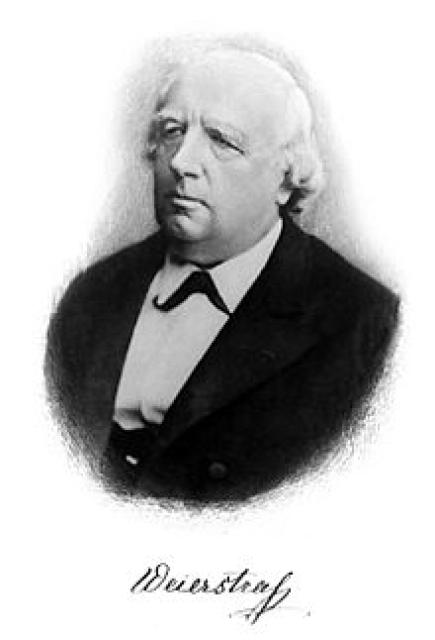
Karl Weierstrass
 Germany
- Biography of Karl Weierstrass
- Early Life and Education
- Contributions to Analysis
- Teaching Career and International Recognition
- Later Life and Legacy
Biography of Karl Weierstrass
Karl Weierstrass was a prominent German mathematician known as the "father of modern analysis." He was born in Ostenfelde, a suburb of Ennigerloh, North Rhine-Westphalia, in a family of civil servants.
Early Life and Education
In 1834, Weierstrass graduated with honors from the gymnasium in Paderborn and, at his father's insistence, enrolled in the law faculty at the University of Bonn. However, instead of studying law, Weierstrass devoted himself to mathematics and eventually left the university to join the Münster Academy in 1838. During his time at the academy, he prepared an examination paper on the theory of elliptic functions, which contained the seeds of his future discoveries.
Contributions to Analysis
In 1841, Weierstrass published a groundbreaking work in which he established that if a sequence of analytic functions uniformly converges within a given region, then the limit of the sequence is also an analytic function. This concept of uniform convergence and the rigorous theory of convergence became one of Weierstrass's most important contributions to the foundation of analysis.
Teaching Career and International Recognition
After working as a teacher at a provincial Catholic school for 14 years, Weierstrass's teaching skills helped him become one of Germany's best educators. He utilized his rare free time, often at night, to pursue mathematical research. In 1854, he published a paper on Abel's functions, for which he was awarded an honorary doctorate by the University of Königsberg. Weierstrass's reputation continued to grow, and he was appointed as a professor at the Industrial Institute in Berlin in 1856. Within a few months, he became an extraordinary professor at the University of Berlin and a member of the Berlin Academy of Sciences. He dedicated 40 years of his life to the University of Berlin.
Later Life and Legacy
In the late 1850s, Weierstrass gained international recognition due to the exceptional quality of his lectures. He covered a wide range of topics, including the theory of analytical functions, elliptic functions, applications of elliptic functions to problems in geometry and mechanics, the theory of Abelian integrals and functions, and variational calculus.
Weierstrass's health suffered from constant exhaustion in his younger years. In 1861, he experienced a severe dizziness attack during a lecture and had to interrupt the class. From then on, Weierstrass always gave lectures while sitting, with one of his best students writing on the board on his behalf.
In 1870, Weierstrass met Sofia Kovalevskaya, a twenty-year-old aspiring mathematician who had come to Berlin to prepare her dissertation. Weierstrass formed a deep affection for his student, which lasted throughout his life, although they never married. He assisted Kovalevskaya in choosing her dissertation topic and provided regular guidance in complex analysis, helping her gain recognition in the field.
After defending her dissertation, Kovalevskaya left Berlin, and their correspondence became infrequent. In 1883, after the death of her husband, Kovalevskaya, now left without means and with a five-year-old daughter, sought refuge with Weierstrass. With great effort and using his influence and connections, Weierstrass managed to secure her a professorship at the University of Stockholm.
Weierstrass's health deteriorated significantly in the later years of his life. He passed away in 1897 due to complications from influenza. In honor of his contributions to mathematics, a crater on the Moon was named Weierstrass, and the Weierstrass Institute for Applied Analysis and Stochastics (WIAS) in Berlin bears his name.


