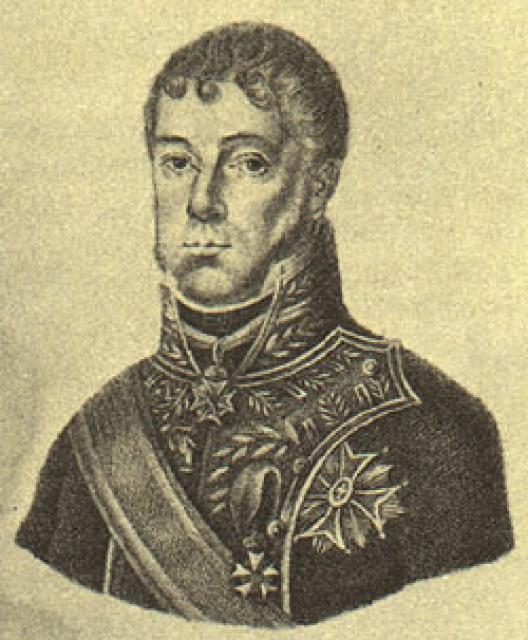
Karl Wrede
 Germany
- The Illustrious Prince and Bavarian Field Marshal
- Military Career
- Distinction in the Napoleonic Wars:
- Command in the Russian Campaign:
- Defection and Victories:
- Honors and Legacy
The Illustrious Prince and Bavarian Field Marshal
Early Life and EducationPrince Wilhelm von Wrede (December 2, 1829 - March 7, 1814) was born into an ancient Bavarian baronial family. As the son of a privy counselor, he received an esteemed education at the Universities of Heidelberg and Munich.
Military Career
Early Engagements and Reforms:- In 1792, Wrede joined the Heidelberg City Council.
- In 1793, he served as a Pfalz territorial commissioner with Hohenlohe's troops.
- In 1799, he commanded the formation of the Palatinate-Bavarian Corps for Archduke Charles's army.
Distinction in the Napoleonic Wars:
- He participated in the Battle of Friedrichsfeld as the head of a rifle regiment.
- In 1800, he protected the Austrian army's retreat and excelled in the Battle of Hohenlinden.
- As a general-major (1800) and later a general of cavalry (1811), he led Bavarian contingents alongside Napoleon.
- In 1809, he commanded the 2nd Bavarian Division, triumphing in battles including Abensberg, Landshut, and Salzburg.
Command in the Russian Campaign:
- He commanded a Bavarian division in Napoleon's Grand Army during the 1812 invasion of Russia.
- After General Deroy's death, he assumed command of the 6th Auxiliary Corps.
- He successfully led his troops back to Vilnius, protecting the retreat of the Grand Army.
Defection and Victories:
- In 1813, he was appointed commander of the Bavarian Corps.- After Bavaria aligned with Napoleon's opponents, Wrede became the commander of the combined Bavarian-Saxon army.
- Despite a defeat at Hanau, he captured 23 cannons at La-Rothière and achieved victories at Brienne, Rosny, and other battles.
Honors and Legacy
- In 1814, Emperor Napoleon granted him the title of Count of the French Empire.
- King Ludwig I of Bavaria bestowed upon him the title of Prince and awarded him the Russian Order of Saint George.
- Wrede's statue stands in Munich and his name is etched in history for his military leadership and role in the Vienna Congress.
- As a member of the Imperial Council and general inspector of the Bavarian army, he played a significant role in the political and military affairs of his time.


