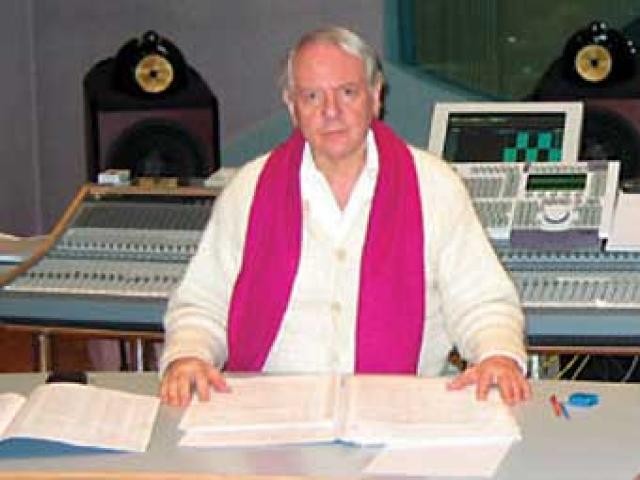
Karlheinz Stockhausen
 Germany
- Biography of Karlheinz Stockhausen
- Early Life and Education
- Contributions to Music
- Major Works
- Conclusion
Biography of Karlheinz Stockhausen
IntroductionKarlheinz Stockhausen was a German composer and one of the greatest innovators of contemporary art. He explored new expressive possibilities in electronic, serial, and aleatoric music. His main idea was the need to perceive music 'point by point', emphasizing the enjoyment of each individual moment rather than the overall dramatic structure.
Early Life and Education
Karlheinz Stockhausen was born on August 22, 1928, in Medrath, near Cologne, Germany. In 1947, he enrolled at the Cologne University of Music, where he later studied with Olivier Messiaen in Paris and worked in Pierre Schaeffer's studio of musique concrte. Stockhausen's electronic studios (1953-1954) were the first to publish and notate electronic music compositions.
Contributions to Music
In the 1960s, Stockhausen became a leading figure in serial music and one of the first European composers to embrace the concept of 'chance' or aleatoric music, where the performer has the freedom to arrange musical fragments in any order. In many of his compositions from the 1960s, live performance of electronic sounds was incorporated. For example, in "Mikrophonie I," two performers move microphones across a tam-tam while four others process the resulting sounds on synthesizers. Other notable compositions from the 1960s include "Telemusik," which features quotes from Japanese traditional music, and "Hymnen," a combination of electronic and concrete sounds.
Major Works
Among Stockhausen's most significant works are "Zeitmae" (1956), an extremely complex composition for five wooden wind instruments; "Gesang der Jnglinge" (1956), a piece of concrete music created from the manipulation of children's voices; "Gruppen" (1958), composed for three orchestras; "Carr" (1960), written for four orchestras and vocalists; "Kontakte" (1960), an electronic music composition; and "Mixtur" (1965), which involves five orchestras, stereo modulators, and loudspeakers playing a pre-recorded magnetic tape. Stockhausen also published many essays on music theory in the German quarterly journal "Die Reihe."
Conclusion
Karlheinz Stockhausen was a pioneering composer who revolutionized contemporary music through his exploration of electronic, serial, and aleatoric techniques. His focus on experiencing music moment by moment and his incorporation of live performance of electronic sounds have left a lasting impact on the world of music.


