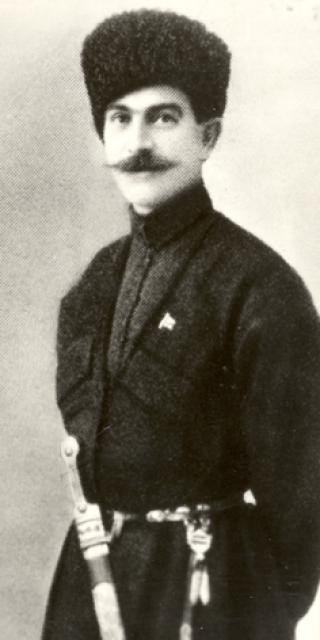
Kayhosro Cholokashvilly
 Georgia
- Biography of Kakutsa Cholokashvili
- World War I and Exploits
- Post-Revolution and Resistance
- Exile and Legacy
Biography of Kakutsa Cholokashvili
Early Life and Military CareerKakutsa Cholokashvili was a Georgian prince and military leader. He was born into the prominent Cholokashvili noble family as the son of Joseph Cholokashvili. He completed his education at the Tiflis Noble Gymnasium in 1907 and subsequently joined the military service. Cholokashvili served in the Tver Dragoon Regiment and retired in 1912. He returned to Georgia and married Princess Nino Megvinetukhutsesi in 1913.
World War I and Exploits
When World War I broke out, Cholokashvili was called back to active duty. He commanded a squadron on the Austrian front and was later transferred to the Caucasian front after being wounded. He distinguished himself in the Battle of Sarikamish and was awarded the Golden Sabre for his bravery. After recovering from his injuries, Cholokashvili participated in the expedition to Persia under the command of General Baratov and joined forces with the British in Mesopotamia.
Post-Revolution and Resistance
Following the February Revolution, Cholokashvili returned to Georgia. In mid-1917, he joined the National Democratic Party and played a role in the formation of cavalry units in the Georgian army. In 1919, he became the deputy minister of defense and commanded a cavalry division in the Georgian-Armenian and Soviet-Georgian wars. After the establishment of Soviet rule in Georgia, Cholokashvili formed a partisan detachment.
Exile and Legacy
In 1922, Cholokashvili initiated an uprising in Kakheti and Khevsureti, but suffered defeat. In 1924, during the August Uprising, he attacked military barracks in Manglisi but was repelled. He then fled to France through Turkey along with his fighters, where he lived until 1930 when he passed away from tuberculosis contracted during World War I. Initially, he was buried at the Simetière de Saint-Ouen cemetery, and later his remains were moved to the Leuville-sur-Orge cemetery in France, which is a traditional burial place for Georgian emigrants.
Kakutsa Cholokashvili's name regained popularity in Georgia in the late 1980s during the national revival movement. His portraits were often seen at protest rallies. On October 19, 1990, his comrade Alexander Sulukhanishvili brought the flag that Cholokashvili held while dying, which became a significant relic during the era of Zviad Gamsakhurdia. Cholokashvili's remains were repatriated from France to Georgia and reburied in the Mtatsminda Pantheon on November 23, 2005. He is considered a national hero of Georgia, and his portrait appears on the 200 lari banknote. A street in Tbilisi, in the Vake district, is named in his honor.


