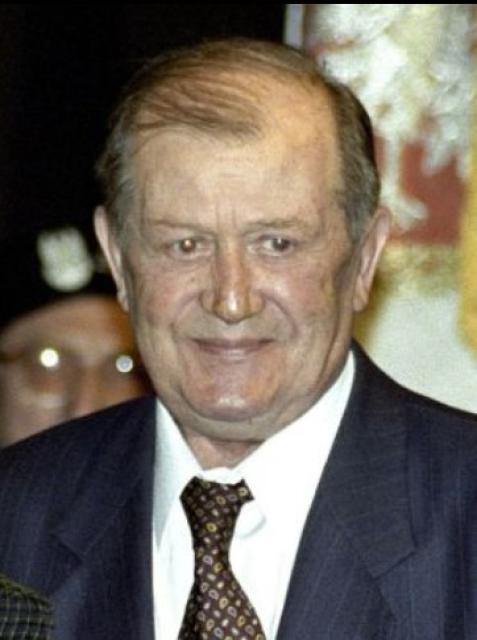
Kazimierz Dejmek
 Poland
- Early Life and Artistic Journey
- Theater Director and Nationalist Poet
- Controversial Masterpiece and Political Turmoil
- International Acclaim and Later Years
- Political Career and Legacy
Kazimierz Dejmek: A Legendary Polish Theater Director and Political Figure
Kazimierz Dejmek, a renowned theater director and actor, left an indelible mark on the Polish theater scene. His artistry was recognized with numerous accolades, while his political activism played a significant role in Poland's history.
Early Life and Artistic Journey
Born to Czech parents, Dejmek actively participated in the Polish resistance movement during World War II. After the war, he embarked on a theatrical career and enrolled in the Łódź Film School in 1949. His directorial debut came in 1947, and he later led various theaters in Poland, including the "Teatr Nowy" in Łódź from 1949 to 1961.
Theater Director and Nationalist Poet
From 1962 to 1968, Dejmek served as the director of the National Theater in Warsaw. His постановки were characterized by their political relevance, notably his production of Bruno Jasieński's "Słowo o Jakubie Szeli" in 1962, which blended traditional and revolutionary elements. Dejmek's performances of Juliusz Słowacki's "Kordian" and Rolf Hochhuth's "The Deputy" also sparked public debate due to their topical themes.
Controversial Masterpiece and Political Turmoil
In 1967, Dejmek's production of Adam Mickiewicz's "Dziady" sparked outrage among the Polish authorities. Władysław Gomułka, the first secretary of the Polish United Workers' Party, denounced the performance as "anti-Russian" and "anti-Soviet," leading to its cancellation. This decision ignited student protests and demonstrations, culminating in the March 1968 events. Dejmek was expelled from the Polish United Workers' Party and removed from his position as theater director.
International Acclaim and Later Years
Despite the setbacks, Dejmek continued to direct productions abroad after 1968, including in Oslo, Düsseldorf, Belgrade, Milan, and Vienna. In 1981, he returned to Poland as the director of the Polish Theater in Warsaw. His artistic legacy includes notable productions of Sławomir Mrożek's plays and a powerful rendition of Anton Chekhov's "Uncle Vanya" in 1969.
Political Career and Legacy
Beyond his artistic achievements, Dejmek engaged in politics, serving as a member of the Polish Sejm on behalf of the Polish Peasant Party from 1993 to 1997. During his tenure as Minister of Culture and Art from 1993 to 1996, he played a key role in shaping Poland's cultural landscape. Kazimierz Dejmek's contributions to Polish theater and society continue to inspire generations of artists and political thinkers to this day.



