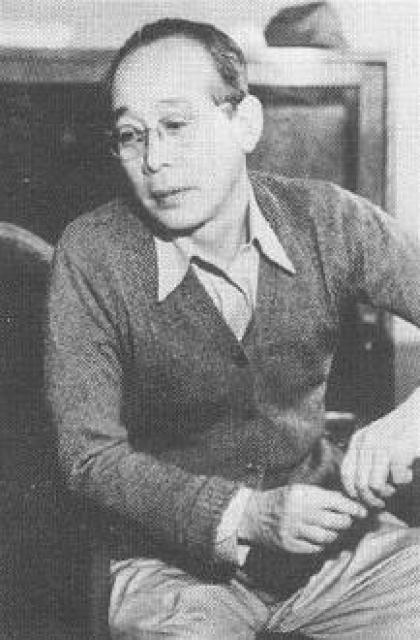
Kenji Mizoguchi
 Japan
Japan- Early Life and Career
- Emerging Style
- Social Realism and Female Empowerment
- World War II and Beyond
- International Acclaim and Legacy
Early Life and Career
Kenji Mizoguchi was born into a poor carpenter's family in Tokyo on May 16, 1898. His childhood was marked by hardship, with his sister Suzu being sold into a geisha house as a young girl. This experience would deeply influence his future work, shaping his focus on the plight of women in Japanese society.
After trying out several occupations, including apprenticing as a kimono pattern designer, Mizoguchi left home in 1915 upon his mother's death. He moved in with his sister, who was being supported by a wealthy patron. He immersed himself in reading, studying art, and found work as an advertising illustrator in Kobe, where he relocated in 1917.
Returning to Tokyo in 1920, Mizoguchi initially aspired to become an actor at Nikkatsu Studios but was employed as an assistant, notably under director Chu Ogata. By 1922-1923, he had debuted as a director, helming adaptations of several domestic and foreign novels, including "Foggy Harbor" based on Eugene O'Neill's "Anna Christie." Most of these early films have been lost.
Emerging Style
In his earliest surviving films, such as "Song of Home" (1925), Mizoguchi presented a contrast between urban and rural life, a theme he would explore in many subsequent works. After the devastating Great Kanto Earthquake in 1923, he relocated to Kyoto and continued making adaptations, including "Nihonbashi" and "Tokyo March."
Mizoguchi's "City Symphony" faced censorship for reflecting the progressive ideas of Japan's leftist literary and artistic movement. Nonetheless, it demonstrated his brilliance in using the "episode shot" technique that would become his signature.
Social Realism and Female Empowerment
Throughout the early 1930s, Mizoguchi's films gained recognition for their social realism, refined form, and focus on women's fate. "White Threads of the Waterfall," "Osen and the Paper Cranes," and "Osaka Elegy" showcased his mature style and recurring themes, such as the plight of women exploited by society.
He began collaborating with screenwriter Yoshikata Yoda, who became an essential contributor to his work. In 1936, Mizoguchi released two critically acclaimed masterpieces: "Elegy of Naniwa" and "The Sisters of Gion," both starring Isuzu Yamada and Yoko Umemura. These films poignantly depicted the harsh fate of prostitutes and the oppressive weight of public opinion.
World War II and Beyond
The new wartime regime condemned "Elegy of Naniwa" and "The Sisters of Gion," forcing Mizoguchi to retreat to historical dramas. However, he continued to refine his style and perfect the episode-shot technique, as seen in "The Story of the Late Chrysanthemums" (1939).
Mizoguchi's triumph with this technique came with his two-part epic "The Forty-Seven Ronin" (1941-1942), which was composed entirely of episode shots. Critics dismissed the ensuing years (1940-1951) as his "Great Eleven-Year Decline."
After the war, Mizoguchi responded to contemporary issues with politically and socially conscious films. He collaborated with the renowned actress Kinuyo Tanaka, whose strength and idealism became synonymous with the "new Japanese woman" in films like "Women of the Night" and "Flame of My Love."
International Acclaim and Legacy
In 1950, "Portrait of Madame Yuki" struck a balance between artistry and social commentary. Mizoguchi's subsequent adaptations of Tanizaki's "Lady Oyu" and Ooka's "Madame Musashino," both starring Tanaka, further elevated her status.
In 1952, "The Life of Oharu" (starring Tanaka) won the Silver Lion at the Venice Film Festival, opening up Japan's cinema to the West. Mizoguchi continued to redefine historical genres with "Ugetsu Monogatari," "Sansho the Bailiff," and "The Tale of Genji."
His final films, "Gion Matsuri," "Woman of Rumor," and "Street of Shame," powerfully criticized feudal remnants and prostitution. His collaboration with scenarist Yoda, cinematographer Kazuo Miyagawa, and regular cast members ensured the artistic unity of his demanding works.
Mizoguchi succumbed to leukemia on August 24, 1956, while preparing "Osaka Story," which his disciple Yoshishige Yoshida completed in 1957. Venice honored Mizoguchi's legacy in 1980, and retrospectives of his films continue to be screened worldwide.


