Khafra
 Ancient Egypt, Old Kingdom of Egypt
Khafra, more commonly written Khafre, ruled Egypt during the Fourth Dynasty, when the kings of the Old Kingdom were building the monumental landscape of Giza. His name is inseparable from the plateau’s second great pyramid, a royal complex that still dominates the skyline beside the Great Pyramid of his father, Khufu. Khafre left few personal details behind, but the scale and precision of his monuments reveal a ruler able to command enormous resources and shape how kingship would be seen for millennia.
A King of the Fourth Dynasty
Khafre was a son of Khufu and a pharaoh of Egypt’s Old Kingdom, which flourished more than 4,500 years ago. His Greek name was Khefren, and Egyptologists use both Khafre and Khafra for the ancient Egyptian ruler. Precise dates for his reign vary among chronologies, but he ruled in the mid-third millennium BCE, after the age of Khufu and before that of Menkaure.
The surviving record says relatively little about his childhood, personality, or daily rule. His reign is best understood through royal inscriptions, sculptures, and the extensive funerary complex built for him at Giza. These remains point to a court with skilled administrators, craftsmen, and laborers, and to a state capable of organizing work on an immense scale.
The Pyramid and Its Sacred Landscape
Khafre’s pyramid is the second largest on the Giza plateau. Built on slightly higher ground than his father’s monument, it appears almost as tall from a distance. A band of smooth casing stones still clings to its upper portion, offering a glimpse of the gleaming limestone surface that once covered the entire structure. The pyramid stood at the heart of a much larger complex that included a mortuary temple, a long causeway, and a valley temple near the edge of the ancient floodplain.
The Great Sphinx lies beside Khafre’s valley temple and causeway. Its face is often identified with the king, and the Egyptian Ministry of Tourism and Antiquities points to archaeological evidence linking its carving to his reign. The precise relationship between ruler, monument, and Sphinx remains a subject of scholarly discussion, but the setting makes the Sphinx an integral part of Khafre’s royal landscape. Its lion body and human head projected an image of kingly power, protection, and divine authority.
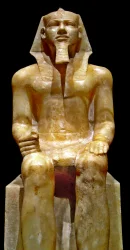
Sculpture from Khafre’s complex gives that royal image remarkable force. The famous seated statue now in Cairo’s Egyptian Museum shows the king enthroned, protected by the falcon god Horus, whose wings enfold the back of his head. The work combines an idealized, calm face with a sense of unshakeable authority, presenting pharaoh as both human ruler and sacred figure.
A Legacy in Stone
Khafre’s monuments helped define Giza as a royal cemetery and a lasting emblem of ancient Egypt. The pyramid complex was not simply a tomb: its temples and causeway supported rituals intended to preserve the king’s presence after death. The care given to its layout and sculpture shows how architecture, religion, and political power worked together in the Old Kingdom.
Little can be said with confidence about Khafre’s personal character, and later Greek writers’ accounts of the pyramid builders do not provide reliable biographies. His legacy instead survives in the stone: a vast pyramid, a network of temples, and a royal image that remains instantly recognizable. Through those monuments, Khafre still commands one of the most famous landscapes in human history.