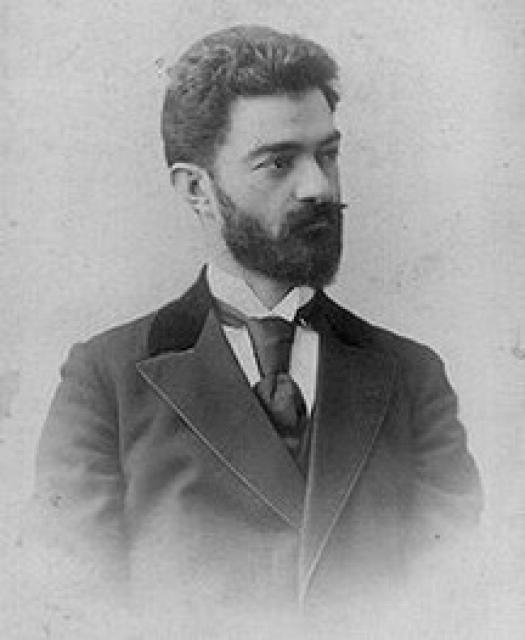
Kita Abashidze
 Georgia
- Kita Abashidze
- Career and Involvement in Manganese Industry
- Political Involvement
- Literary Criticism and Scholarship
- Death and Legacy
Kita Abashidze
Early Life and EducationKita Abashidze was born on January 28, 1870, to a noble family in the village of Lesa, Ozurgeti district, Kutaisi province. He attended Kutaisi Classical Gymnasium, graduating in 1889. Subsequently, he spent ten months in Paris, where he studied philosophy, literature, and the history of art. He then pursued a law degree at the University of Odessa from 1890 to 1895.
Career and Involvement in Manganese Industry
After completing his studies, Abashidze worked in Tiflis as a control chamber officer. He later became an arbitrator in Racha and Chiatura. In 1893, he entered the field of journalism, regularly contributing literary critiques to Georgian publications. In the early 1890s, he became involved in the management of the manganese mining industry in Chiatura. He later led the Industrial Commission for Manganese Mining.
Political Involvement
Abashidze co-founded the Socialist-Federalist Party in 1901 and became one of its key leaders. He actively participated in the revolutionary events of 1905 and was arrested twice, in 1905 and 1909. However, influential relatives secured his release on both occasions.
After the February Revolution, Abashidze was appointed Commissioner of Education by the provisional government's decree on March 9, 1917. However, he did not actively participate due to illness and was soon replaced by Akaki Chkhenkeli.
Literary Criticism and Scholarship
Abashidze made significant contributions to the field of literary criticism. Using the comparative-historical method, he classified Georgian literature into schools and movements. He meticulously analyzed the works of Georgian writers and determined their affiliation based on critical examination of primary sources. Abashidze incorporated materialist explanations into his literary analyses, but he ultimately attributed literary phenomena to political and cultural factors, in line with the principles of Hippolyte Taine and Georg Brandes.
His literary essays had a profound impact on the development of Georgian literature. His seminal work, "Studies in Georgian Literary History of the Century," established the history of Georgian literature as a scientific discipline.
Death and Legacy
Kita Abashidze passed away in Tbilisi on November 30, 1917, from spinal tuberculosis. He was buried in Didube Pantheon. His contributions to Georgian literature and scholarship continue to inspire and guide literary criticism and research in the 21st century.


