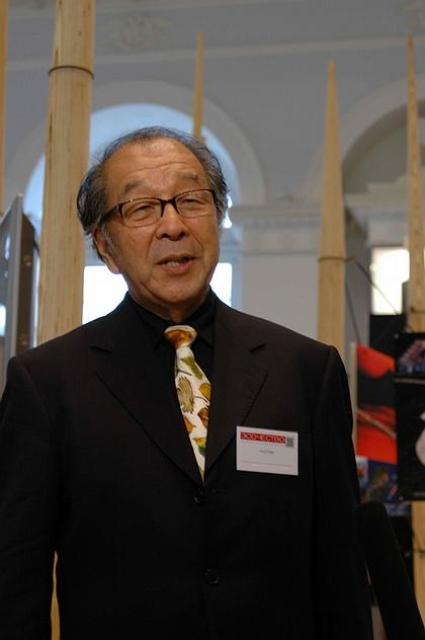
Kiyonori Kikutake
 Japan
Japan- Kiyonori Kikutake: A Visionary of Metabolist Architecture
- Honors and Affiliations
- Conceptual Projects
- The Sky House: A Manifesto of Metabolism
- High-Density Buildings and Megastructures
- Metabolist Architecture
- Key Projects
Kiyonori Kikutake: A Visionary of Metabolist Architecture
Early Life and EducationKiyonori Kikutake, a renowned Japanese architect, was born on April 1, 1928, in Kurume, Fukuoka Prefecture. In 1950, he graduated from Waseda University with a degree in architecture.
Honors and Affiliations
Kikutake held prestigious positions including Honorary Fellow of the American Institute of Architects (AIA), Academician of the International Academy of Architecture, and President of the Japan Institute of Macroengineering. He also served as a mentor and employer to notable Japanese architects such as Toyo Ito, Shoji Uchi, and Itsuko Hasegawa.
Conceptual Projects
Kikutake's early concepts, such as the Marine City Project and Floating System, showcased his innovative ideas. These concepts aimed to create sustainable urban environments that could adapt to changing needs and population growth.
The Sky House: A Manifesto of Metabolism
In 1960, Kikutake's Sky House and Izumo Shrine introduced the concept of metabolist architecture. Metabolist architecture emphasized the integration of tradition into contemporary designs. The Sky House, designed and built within a year, featured a circular gallery surrounding an open interior space. Its adjustable components and movable units allowed for flexible configurations as the family's needs evolved.
High-Density Buildings and Megastructures
Kikutake's work addressed the challenges of urban density. In the Habitat project, he explored the design of high-rise buildings capable of maximizing space utilization. His designs for megastructures and super-tall skyscrapers sought to create self-contained urban environments.
Metabolist Architecture
Metabolist architecture, inspired by principles of organic growth and evolution, emerged as an alternative to functionalist architecture. Practitioners like Kikutake believed in the dynamic nature of buildings and cities, which should adapt and change over time.
Key Projects
1958: Sky House, Tokyo1958: Marine City
1960: Metabolism
1963: Tatebayashi Civic Center
1963: Izumo Shrine Office Building
1966: Pacific Hotel, Chigasaki
1966: Miyakonjo City Council
1970: Osaka Expo Tower
1973: Marine City
1976: Matsumi Tower
1978: Works and Method
1979: Tanabeshi Museum of Art
1987: Seiyo Ginza Hotel, Tokyo
1989: Edo-Tokyo Museum
1994: Sofitel Hotel, Tokyo
1995: Megastructure
1999: National Showa Memorial Museum
1999: Shimane Art Museum
2005: Kyushu National Museum
Legacy and Impact
Kiyonori Kikutake passed away in 2011. His pioneering work in metabolist architecture continues to inspire contemporary architects and designers worldwide. His ideas of adaptability, sustainability, and urban innovation have left a lasting legacy in the field of architecture.