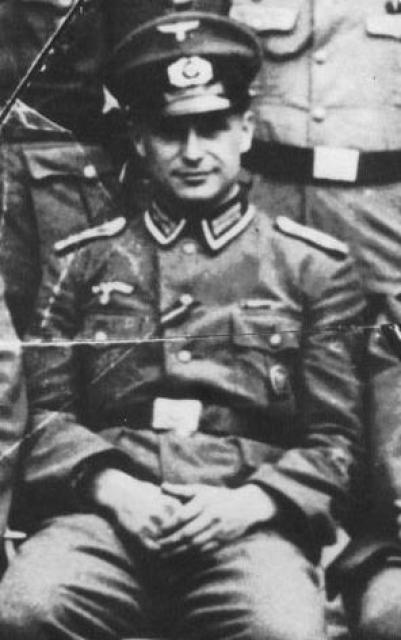
Klaus Barbie
 France
- From the SS to Occupied France
- Arrests, Torture, and Deportations
- Postwar Escape and Extradition
- Trial and Legacy
Klaus Barbie was a Nazi SS officer and the Gestapo chief in Lyon, France, during the German occupation. He became known as the “Butcher of Lyon” for the torture, arrests, and deportations carried out under his command. After the war, he escaped prosecution with help from U.S. Army intelligence and lived for decades in South America under a false name. In 1987, a French court convicted him of crimes against humanity and sentenced him to life in prison.
From the SS to Occupied France
Nikolaus “Klaus” Barbie was born on October 25, 1913, in Bad Godesberg, Germany. He joined the Nazi Party in 1932 and the SS in 1935, later working for the Security Service and training as an interrogator. After Nazi Germany occupied the Netherlands in 1940, he was assigned to intelligence work there. In 1942, he was transferred to France, first to Dijon and then to Lyon.
Lyon was a major center of the French Resistance. As a senior Gestapo officer, Barbie led the repression of resistance networks and the persecution of Jews. His headquarters became a site of brutal interrogations. Estimates attribute thousands of murders and executions and the deportation of roughly 7,500 Jews from the region to Barbie’s actions.
Arrests, Torture, and Deportations
In June 1943, Barbie’s Gestapo arrested Resistance leader Jean Moulin and other members of the resistance in Caluire, near Lyon. Moulin was tortured in custody and died from its effects several weeks later. Barbie also oversaw the deportation of Jewish prisoners from Lyon, including 86 people seized in a February 1943 roundup.
On April 6, 1944, Barbie led the raid on the children’s home at Izieu. Gestapo officers seized 44 Jewish children and seven adults who cared for them. They were sent to transit camps and then deported; most were murdered at Auschwitz. The roundup became one of the most notorious crimes associated with his time in France.
Postwar Escape and Extradition
Barbie left Lyon as German forces retreated in 1944. After the war, the French government sought him for prosecution, but in 1947 the U.S. Army Counter-Intelligence Corps recruited him as an informant, using his knowledge of French intelligence and communist activity. In 1951, the CIC helped him and his family escape to South America through a postwar route used by former Nazis.
He settled in Bolivia as Klaus Altmann, where he built business connections and received protection from political allies. Nazi hunters Serge and Beate Klarsfeld identified him in the early 1970s and campaigned for his return to France. After years of delay, Bolivia extradited him in 1983.
Trial and Legacy
Barbie’s trial opened in Lyon in May 1987. It was the first trial in France for crimes against humanity and became a major public reckoning with the Holocaust, the Resistance, and French collaboration. Witnesses, survivors, and relatives of victims described the consequences of the crimes committed under his authority. The court found him guilty of 17 crimes against humanity and sentenced him to life imprisonment on July 4, 1987.
Barbie died of cancer in French custody on September 25, 1991. His case remains a stark example of how postwar intelligence calculations helped a war criminal evade justice for decades, and of the role survivor testimony and historical investigation played in bringing him to trial.


