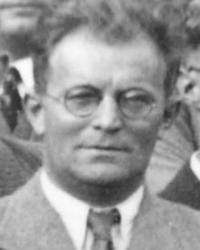
Klinton Davisson
 USA
USA- Clinton Joseph Davisson: A Pioneering Physicist
- Career at Bell Labs
- Discovery of Electron Diffraction
- Nobel Prize and Later Work
- Post-Bell Labs Legacy
Clinton Joseph Davisson: A Pioneering Physicist
Early Life and EducationClinton Joseph Davisson, an American physicist, was born in Bloomington, Illinois, on October 22, 1881. The only son of Joseph Davisson, a painting contractor, and Mary (Calvert) Davisson, a schoolteacher, Davisson showed exceptional aptitude for physics while attending Bloomington High School, graduating in 1902.
During his undergraduate studies at the University of Chicago, Professor Robert A. Millikan recommended Davisson for a vacant teaching position at Purdue University, where he taught physics from 1903 to 1904. Returning to Chicago, he became an instructor in physics at Princeton University in 1905. Completing his dissertation in four summer sessions at the University of Chicago, Davisson earned a Bachelor of Science degree in 1908.
At Princeton, Davisson worked as an assistant to British physicist Owen W. Richardson, who advised his doctoral dissertation. In 1911, Davisson obtained a doctorate in physics and a master's degree in mathematics, with his doctoral thesis focusing on "On the Thermal Emission of Positive Ions From Hot Bodies," a topic related to thermionic emission.
Career at Bell Labs
Following his marriage to Richardson's sister, Charlotte Sarah, Davisson relocated to Pittsburgh when he became an assistant professor at Carnegie Institute of Technology. Despite a heavy teaching load, he managed to publish one paper based on his research within six years.
With the outbreak of World War I in 1917, Davisson attempted to volunteer but was rejected due to his frail physique. Nonetheless, he secured a leave of absence from Carnegie Institute of Technology to join the engineering department of Western Electric, where he worked on developing electron tubes for military communication. These tubes acted as electronic valves, controlling the flow of electrons from a heated filament to a positively charged metal plate, with the voltage on a metal grid between them modulating the electron flow.
Despite the demands of his wartime research, Davisson continued to pursue fundamental physics problems. He soon earned a reputation as an inventive and meticulous experimentalist, overcoming numerous challenges. After the war, Davisson remained at Western Electric, which later became Bell Telephone Laboratories. There, he conducted research on thermionic emission and the emission of electrons from metals when bombarded with electrons, seeking to understand the mechanisms behind the emission of electrons from hot filaments in electron tubes, the malfunctioning of which rendered the tubes useless.
Discovery of Electron Diffraction
In 1919, Davisson began investigating the interaction of electrons with metal surfaces, directing electron beams at these surfaces and measuring the velocity, energy, and emission angles of the secondary electrons emitted by the surfaces. Along with his colleague C.H. Kunsman, Davisson performed measurements of electron scattering from polycrystalline metals, but they were unable to explain the results.
In 1925, German physicist Walther Elsasser hypothesized that the scattering pattern could be attributed to the wave-like nature of electrons, a concept first proposed by French physicist Louis de Broglie. According to de Broglie, the wavelength of an electron is inversely proportional to its velocity. Elsasser suggested that at the voltages Davisson was using, the wavelength of the electrons became comparable to that of X-rays, which interact effectively with the atomic lattice of metal crystals. However, Elsasser's failure to experimentally confirm his hypothesis led Davisson to dismiss it.
In 1925, during an electron scattering experiment using a nickel target, the target became severely oxidized due to a vacuum breach. To remove the nickel oxide, Davisson and Lester H. Germer annealed the target first in hydrogen and then in a vacuum. Focusing a beam of high-velocity electrons on different faces of the crystalline nickel target, they measured the number of electrons reflected at different angles. The electrons initially scattered elastically, much like rubber balls bouncing off a solid wall. However, after the changes in the crystal structure of the target caused by the heat treatment, they observed a strong dependence of the distribution of scattered electrons on the crystal's orientation.
Nobel Prize and Later Work
Attributing the altered angular distribution of scattered electrons to electron diffraction, Davisson and Germer investigated electron scattering on single-crystal targets. At the 1926 meeting of the British Association for the Advancement of Science, Davisson discussed his experimental results with Max Born, James Franck, and P.M.S. Blackett. They convinced him of the validity of Elsasser's interpretation and that his observed electron scattering patterns were due to the interaction of de Broglie waves.
Upon returning to his laboratory, Davisson began a systematic search for phenomena related to the interference of de Broglie waves. In January 1927, he observed electron beams arising from diffraction on a nickel single crystal. The experimental results provided excellent confirmation of de Broglie's wave theory of matter, specifically electrons.
In 1937, Davisson and J.P. Thomson were awarded the Nobel Prize in Physics "for their experimental discovery of the diffraction of electrons by crystals." Both laureates had demonstrated the same phenomenon, though Thomson worked independently using different methods. In his award address, Hans Pleijel of the Royal Swedish Academy of Sciences remarked that Davisson and Thomson's achievements not only "greatly enriched... our knowledge of the nature of electrons" but also "led to... the first positive, experimental proof of the wave nature of matter."
In his later years, Davisson shifted his focus to research in electron optics, particularly its technical aspects. His studies of electron beams interacting with electric and magnetic fields in space contributed to Ernst Ruska's invention of the electron microscope in 1939.
Post-Bell Labs Legacy
Following his retirement from Bell Labs in 1946, Davisson became a visiting professor at the University of Virginia, where he remained until 1954. On February 1, 1958, Davisson passed away in Charlottesville, Virginia.
Davisson was a member of numerous scientific societies, including the National Academy of Sciences and the National Research Council. Among his many honors, he received the Comstock Prize of the National Academy of Sciences (1928), the Elliott Cresson Medal of the Franklin Institute (1931), the Hughes Medal of the Royal Society of London (1935), and the University of Chicago Alumni Medal (1941). He was awarded honorary doctorates from Purdue University, Princeton University, Lyons University, and Colby College.