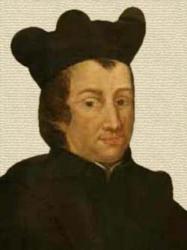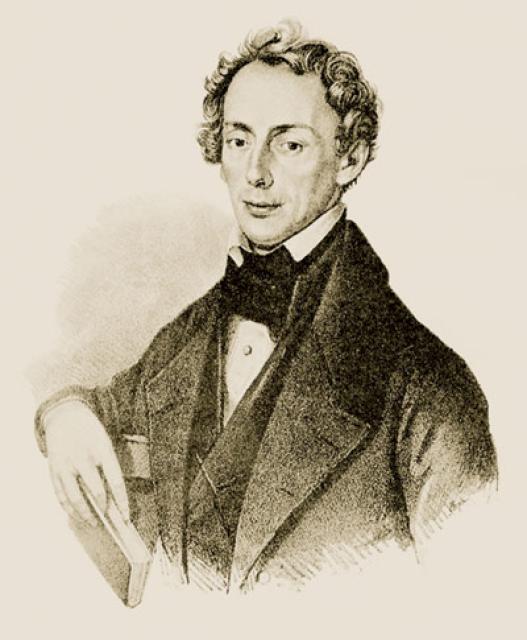
Kristian Doppler
 Austria
Biography of Christian Doppler
Christian Doppler, an Austrian physicist, was born on November 29, 1803, in Salzburg. He completed his studies at the Polytechnic Institute in Vienna in 1825. From 1835 to 1847, Doppler worked in Prague, and in 1847, he became a professor at the Mining and Forestry Academies in Chemnitz. In 1848, he became a member of the Vienna Academy of Sciences and, in 1850, a professor at the University of Vienna. He also served as the director of the world's first Physics Institute, established at the University of Vienna through his initiative.
Scientific Interests
Christian Doppler's scientific interests lay in the fields of optics and acoustics. His major works focused on the aberration of light, the theory of the microscope and optical rangefinder, the theory of colors, and several other topics. In 1842, Doppler theoretically substantiated the relationship between the frequency of oscillations perceived by an observer and the velocity and direction of motion of the wave source and the observer relative to each other. This phenomenon was later named after him as the "Doppler effect." The main cause of the Doppler effect is the change in the number of waves fitting along the path of propagation between the source and receiver. While keeping the wavelength emitted by the source constant, this leads to a change in the number of waves reaching the receiver per second, i.e., a change in the frequency of the received oscillations. In 1848, the Doppler effect was refined by the French physicist Armand Fizeau and, in 1990, experimentally verified by A. A. Belopolsky in a laboratory setup. The Doppler principle has found numerous applications in astronomy for measuring the velocities of stars along the line of sight and their rotation around an axis, turbulent flows in the solar photosphere, and more. It has also been widely used in various fields of physics and technology, including radar systems used by traffic police.
Death and Legacy
Christian Doppler passed away on March 17, 1853, in Venice. His contributions to the understanding of wave phenomena and the development of the Doppler effect have had a lasting impact on the scientific community. Doppler's work continues to be studied and applied in various branches of physics and engineering, making him one of the notable figures in the history of science.