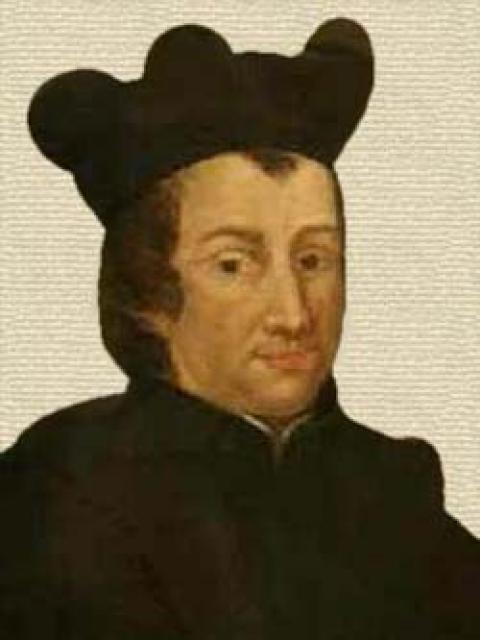
Franchesko Grimaldy
 Italy
ItalyBiography of Francesco Grimaldi
Francesco Grimaldi (2nd April 1618 - 28th December 1663) was an Italian physicist and astronomer who is known for his contribution in creating the first map of the Moon.
Early Life and Education
Grimaldi was born in Bologna, Italy. He studied philosophy, rhetoric, and theology from 1637 to 1645, and in 1647, he obtained his doctorate degree. He later became a professor at the Jesuit College in Bologna, initially teaching philosophy and later mathematics.
Contributions to Science
In 1651, Grimaldi became a priest and dedicated himself to scientific research. His most notable work, "Physical Science on Light, Colors, and Rainbows," was published in 1665, after his death. This work contained the majority of his findings as an experimental physicist and philosopher.
Grimaldi discovered and extensively studied the phenomenon of light diffraction, formulating several rules. He provided detailed descriptions of light propagation, reflection, refraction, diffraction, vision, and presented his contradictory theories on the nature of light. He developed a theory of colors, considering color as a "modification of light." Grimaldi also described the solar spectrum obtained by using a prism.
In collaboration with Giovanni Riccioli, Grimaldi determined the size of the Earth's surface in 1662.
Legacy
Francesco Grimaldi's contributions to the field of physics and astronomy have had a lasting impact. His discoveries and theories on light diffraction laid the foundation for future research in optics. Grimaldi's work on the nature of light and his theory of colors also influenced the development of the field. His determination of the Earth's surface size demonstrated his multidisciplinary approach to scientific inquiry.
Although Grimaldi's work was not widely recognized during his lifetime, his posthumous publication ensured his contributions to science were acknowledged and celebrated.