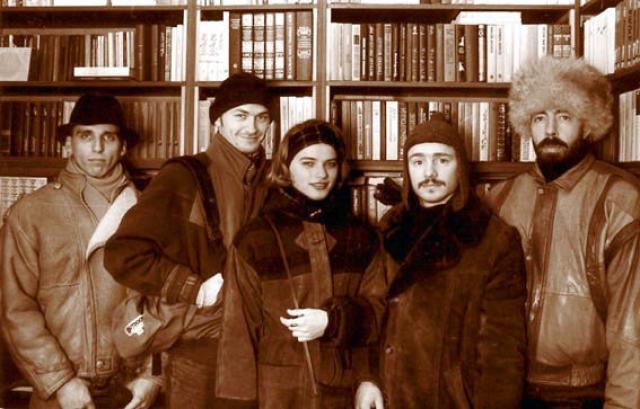
Kujbul
 Moldova
- Roots in the Underground
- The Moscow Crucible
- From Moldova to the World
- Emergence of a Signature Style
- International Acclaim and Artistic Evolution
- Club Scene Catalyst and Festival Triumphs
Roots in the Underground
The genesis of the band can be traced back to the vibrant school dance scene, where they cut their teeth on covers of legendary Soviet rock bands such as "Mashina Vremeni," "Voskresenye," and "Kruiz." The original lineup comprised Vasil Nagirnyak on bass guitar, Andrei Kostin on guitar, Alexandr Mindin on drums, Sergei Iliev on trumpet, Victor Bordian on trombone, Igor Koselyan on saxophone, and the enigmatic Igor Dynga on guitar, vocals, and the majority of the songwriting duties.
The Moscow Crucible
In a fortuitous twist of fate, Dynga served his military service in Moscow's Sokolniki Park from 1986 to 1988, witnessing the flourishing of Perestroika and the ascendancy of the Russian rock movement. Over two years, he immersed himself in the live music scene, attending over a hundred concerts and forging connections with individuals who would later shape the domestic show business landscape. "Brigada S" emerged as a particular favorite during this period.
From Moldova to the World
Upon returning to Chișinău in 1989, Dynga's energy and ambition propelled him to pursue his musical aspirations. He enrolled at the music academy as a conductor of an estrada orchestra. The band's early sound bore a striking resemblance to their contemporaneous influences, "Auktion" and "Brigada S." Their debut performance took place at a joint concert with Kiev's "Rabota Ho" on February 22, 1991, in Chișinău.
Their first major concert with "Auktion" followed in April 1991 in Chișinău. A pivotal moment came in May 1991 at a charity festival in Krasnodar, commemorating the 5th anniversary of the Chernobyl disaster, which provided the band with their initial exposure to the Russian audience. At the "Cireșar" festival in June 1991, Dynga had the good fortune to encounter Garik Sukachev and Sergei Galanin, ultimately leading to "Kuybul's" first radio airplay in Moscow on SNC Radio. However, the instability of the horn section led the band to evolve towards a guitar-driven sound, albeit with "saxophone treatment by Igor Koselyan," as the press described it at the time.
Emergence of a Signature Style
In May 1992, "Kuybul" recorded their debut album, "Красивые песни - лучшие песни" (Beautiful Songs - Best Songs), showcasing nine tracks that leaned heavily towards guitar-driven new wave and bore stylistic similarities to The Cure and Midnight Oil. They made their international debut at the "Tavriyskie Igry-500" festival in Ukraine in August 1992, sharing the stage with "Agata Kristi" and "Koshkin Dom."
Late in 1992, they recorded a six-song EP titled "Люди, как птицы - прыгайте в воду!" (People, Like Birds - Dive into the Water!). This release marked the inception of their first overseas tour, a two-week expedition across Germany. The transformative experience of witnessing performances by Red Hot Chili Peppers, Stone Temple Pilots, and Sound Garden left a profound impact on the band's artistic trajectory.
Autumn 1993 heralded a significant shift in the lineup. Andrei Boiko, a seasoned bass guitarist with a distinguished history in renowned Moldovan bands such as "Te-Art," "Port Zurbagan," and Doina and Ion Aldea Teodorovici's band, joined the fold. His arrival had a substantial effect on the band's arrangements and the overall dynamism of their live performances.
In a whirlwind of creativity, "Kuybul," now a quartet, underwent a radical transformation within the span of two weeks of rehearsals and ten days of recording at SNC Studio in Moscow. The resulting album, "Ломайте ветки, Ломайте палки" (Break the Branches, Break the Sticks), was a sonic departure featuring infectious guitar riffs, a potent rhythm section, interwoven with Moldovan folk melodies, romantic melodies, and heartfelt lyrics. The album's release in 1994 represented the first officially issued CD from a Moldovan musical act. The presentation concert at Chișinău's MALS club featured an up-and-coming band that would later rise to prominence as "Zdob și Zdub."
International Acclaim and Artistic Evolution
While residing temporarily in Germany, Igor Dynga established his own record label, Dinga-Dringa Music, and in March 1994, released "Kuybul's" limited-edition debut CD. The album was presented in Munich as a precursor to their second German tour. However, the economic turmoil plaguing the former Soviet Union rendered the rock music industry unprofitable, leaving the release largely unnoticed. The friendship with Sergei Galanin proved instrumental, as it paved the way for a review of the album in the prestigious "Komsomolskaya Pravda" newspaper. The music industry circulated numerous copies of the album, and tracks such as "Kolybelnaya" (Lullaby), "Molokosos" (Youngster), and "Sheila" became hits on St. Petersburg's "Katyusha" radio station.
A period of creative restlessness followed, as the band experimented with avant-garde jazz, attending concerts by John Zorn and Mr. Bungle. The latter's album became a constant source of inspiration, serving as a catalyst for the band's metamorphosis. "Kuybul" returned to their brass-heavy roots, recruiting three additional horn players and a new jazz drummer, Vadim Tikhshan, who collectively breathed fresh life into the band's sound.
In May 1995, the revamped "Kuybul" debuted their new repertoire at the "Live Rock Night" international festival in Bucharest, Romania. After two months of recording, the band released "Ikar" on December 22, 1995, in Chișinău. The album displayed a remarkable diversity, with older compositions rearranged and new tracks infused with the spirit of jazz-rock impressionism. The experimental nature of the music made it a challenging listen for mainstream audiences, while the expanded eight-piece lineup hindered the band's ability to secure lucrative gigs.
Nonetheless, the organizers of the "Est-Qest Festival-96" in Valencia, France, were captivated by "Kuybul's" unique sound. The "Ikar" album, adorned with artwork inspired by Matisse, was dispatched to France, and the band embarked on a two-week tour across the south of the country. The warmth and hospitality they encountered inspired a more upbeat, pop-oriented sound.
Club Scene Catalyst and Festival Triumphs
Upon their return from France in the autumn of 1996, "Kuybul" recorded five new tracks, which they presented to Russian record labels as "Demo No. 5." In December, Dynga leased a semi-basement space in the building housing the Luceaferul Theater in Chișinău and established the first rock club in Moldova, aptly named "Kuybul." The club played a pivotal role in fostering the underground club scene in the country. The ambiance of the venue would heavily influence the concept behind the band's next album, with songs composed during unforgettable parties held at the club.
In the summer of 1997, "Kuybul" graced the stages of several festivals. They performed at the DDT Theater's rock festival in St. Petersburg in June and the


