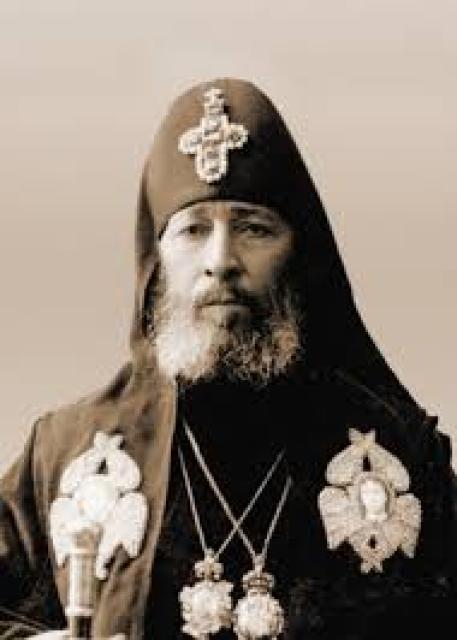
Kyrion II
 Georgia
- Early Life and Education
- Career in the Georgian Church
- Monasticism and Episcopal Consecration
- Exile and Restoration
- Episcopal Missions and Persecution
- Rehabilitation and Tragic End
- Assassination and Legacy
- Sainthood and Veneration
Early Life and Education
Bishop of the Georgian Orthodox ChurchBishop Kyrion Sadzaglishvili was born on November 10 (22), 1855, in the village of Nikozi, Georgia. He hailed from a priestly family and pursued his education at the Tiflis Theological Seminary in 1876 and the Kiev Theological Academy in 1880, where he graduated with a master's degree in theology.
Career in the Georgian Church
Scholarly Pursuits and Ecclesiastical RolesAfter his graduation, Kyrion returned to Georgia and held various positions in the Georgian Orthodox Church. He served as an assistant inspector at the Odessa Theological Seminary and later became an assistant curator at the Telavi and Gori Theological Schools. During this period, he published historical works under the pseudonyms Iverieli and Nikozeli, studying and collecting Georgian manuscripts and coins, and sponsoring talented students.
Monasticism and Episcopal Consecration
In 1896, following the loss of his wife and children, Kyrion was tonsured a monk and subsequently ordained a hieromonk. He became the abbot of the Kvabtakhevi Uspensky Monastery and the ecclesiastical supervisor of Georgian monasteries. In 1898, he was elevated to the rank of archimandrite and consecrated as Bishop of Alaverdi, a vicar of the Georgian eparchy.
Exile and Restoration
Advocate for Autocephaly and PunishmentAs the debate over the future of the Georgian Church intensified, Kyrion became a staunch supporter of restoring its autocephaly. His outspoken advocacy led to his exile to Kamenets-Podolsk. However, in 1902, he was reappointed as Bishop of Balt, a vicar of the Podolia eparchy.
Episcopal Missions and Persecution
Over the next few years, Kyrion served as a vicar bishop in several eparchies, including Novo-Mirgorod, Orlov, and Suhum. His ecclesiastical career culminated in his appointment as Bishop of Kovno, a vicar of the Lithuanian eparchy. However, the murder of the Russian exarch in Tbilisi in 1908 resulted in the removal of Georgian bishops from their posts. Kyrion was defrocked and exiled to monasteries in Kharkov and Tambov.
Rehabilitation and Tragic End
In 1915, Kyrion was reinstated as Bishop of Polotsk and Vitebsk. After the fall of the monarchy in 1917, he retired from his bishopric and returned to Georgia. In March 1917, the autocephaly of the Georgian Church was proclaimed, and Kyrion was elected its first Catholicos-Patriarch.
Assassination and Legacy
Installation and MurderOn October 1, 1917, Kyrion was enthroned as Catholicos-Patriarch in Mtskheta. However, on June 27 (July 10), 1918, he was brutally murdered in his residence in Martkopi. The circumstances surrounding his assassination remain shrouded in mystery.
Sainthood and Veneration
Kyrion's remains were interred in the Sioni Cathedral. In 2002, he was canonized by the Holy Synod of the Georgian Orthodox Church, and his feast day is celebrated on June 27 (Julian calendar) in the Georgian Church.


