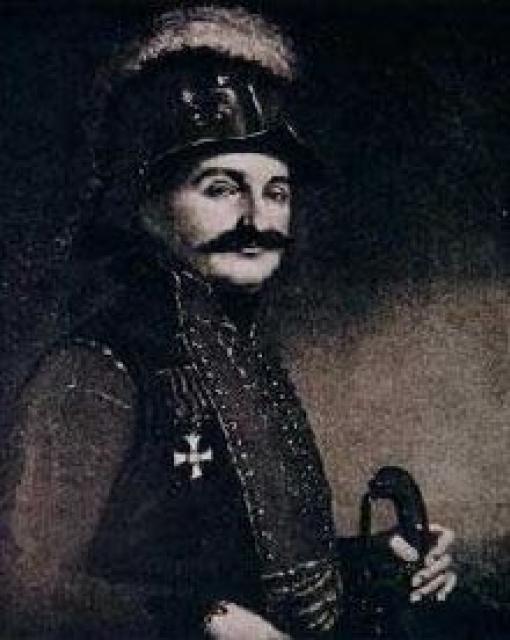
Lambros Katsonis
 Greece
- Lampros Katsonis: A Pillar of the Greek National Liberation Movement
- Military Career
- Lykourgos Katsonis: A Distinguished Army Officer
- Later Career
- Alexander Katsonis: A Civil Servant and Crimean War Hero
- Recognition
- Descendants and Legacy
- Lampros Katsonis in Later Years
- Recognition and Honor
- War and Rebellion
Lampros Katsonis: A Pillar of the Greek National Liberation Movement
Early Life and FamilyLampros Katsonis, a pivotal figure in the Greek struggle for independence from Ottoman rule, was born in Livadia, Greece. Little is known about his early years. At the age of 17, Katsonis, his brother, and other Greek volunteers joined the Mediterranean squadron led by Admiral Grigory Spiridov. Tragedy struck when his brother perished in a naval battle.
Military Career
Katsonis subsequently enlisted in the Russian Jaeger Corps, participating in amphibious landings with the Russian fleet. By the end of the war, he held the rank of sergeant. He later married Angelina Maria Sophianu, the daughter of a Turkish commandant on an Aegean island. The couple had two sons, Lykourgos and Alexander.
Lykourgos Katsonis: A Distinguished Army Officer
Military ExploitsLykourgos Katsonis exhibited great valor during the Отечественной войны 1812 (Patriotic War of 1812) and the subsequent foreign campaigns. He was decorated with the medals "In Memory of 1812" and "For the Capture of Paris." In 1823, he joined the Balaklava Greek Infantry Battalion.
Later Career
During the Russo-Turkish War of 1828-29, Katsonis's distinguished service earned him a promotion to major and the medal "For the Turkish War of 1828-29." In 1831, he became the commander of the Balaklava Greek Division. He later served in the Caucasus under the command of General Mikhail Vorontsov and rose to the rank of colonel.
Alexander Katsonis: A Civil Servant and Crimean War Hero
Military Service and CareerAlexander Katsonis pursued a different path, enrolling in the Mingrelian Infantry Regiment after studying in Odessa. After a brief stint in a dragoon regiment in St. Petersburg, he retired in 1827 and settled in Crimea. There, he held various civil service positions.
Recognition
During the Crimean War, Katsonis played a key role and was awarded the Order of St. Anna, 2nd degree.
Descendants and Legacy
Alexander Likurgovich Katsonisserved as a midshipman in the Black Sea Fleet before transferring to the Baltic. In 1869, he presented his grandfather's legendary weapon to King George I of Greece, where it was permanently displayed in the museum at the University of Athens.
Spiridon Alexandrovich Katsonis, Katsonis's great-grandson, became a renowned lawyer and later an acclaimed author. His famous work, "In the Depths of Crimea," chronicled the exploits of his illustrious ancestor.
Lampros Katsonis in Later Years
In 1775, Katsonis relocated to Kerch. He distinguished himself in suppressing a Tatar rebellion in 1777-78, earning him an officer's commission. In 1781, he was sent to Persia under the command of Count Ivan Voinovich.
Recognition and Honor
In 1785, Catherine II of Russia granted Katsonis Russian nobility. Prince Potemkin promoted him to the rank of captain for his services in the Persian expedition. In 1790, he was elevated to the rank of colonel and awarded the Order of St. George, 4th class, for his gallantry in battle.
War and Rebellion
Amidst rising tensions between Russia and Turkey in 1787, Katsonis organized a group of Greeks. On October 11, 1787, they captured a Turkish vessel near modern-day Odessa. The captured ship was renamed "Prince Potemkin-Tavrichesky," a testament to Katsonis's enduring legacy as a symbol of Greek resistance and aspirations for freedom.





