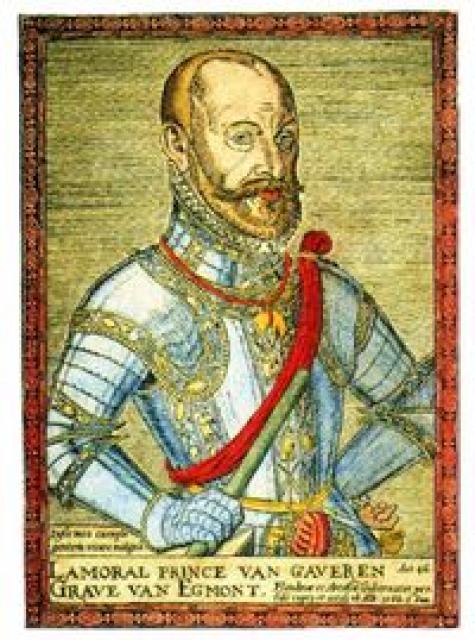
Lamoral Egmont
 Spain
Spain- Lamoraal, Count of Egmont: A Life of Conflict and Execution
- Resistance to the Inquisition
- Reconciliation and the Madrid Embassy
- The Iconoclast Fury and the Rise of Alba
- Arrest and Execution
- Legacy in Art
- - Johann Wolfgang von Goethe's tragedy "Egmont" (1788)
- - Giuseppe Verdi's opera "Don Carlos" (1867)
Lamoraal, Count of Egmont: A Life of Conflict and Execution
Early Life and Military CareerLamoraal, Count of Egmont (1522-1568), was born into one of the most prominent noble families in the Netherlands. Raised and educated at the court of Charles V, he inherited his brother's estates in 1542 and married Sabina, Duchess of Bavaria, in 1544. In 1544, he became a knight of the Order of the Golden Fleece. As a member of the Spanish army, Egmont fought in the victorious battles of Saint-Quentin (1557) and Gravelines (1568), where he commanded the Spanish forces. In 1569, he was appointed stadtholder of Flanders and Artois.
Resistance to the Inquisition
In 1563, Egmont joined forces with William of Orange and Philip of Montmorency, Count of Horn, to protest against the excesses of the Inquisition led by Cardinal Antoine Granvelle. This protest led to the Compromise of Nobles, which sought to moderate the persecution of Protestants.
Reconciliation and the Madrid Embassy
Despite his opposition to the Inquisition, Egmont maintained a close relationship with King Philip II of Spain. In 1565, he led a delegation of Flemish nobles to the Spanish court to petition for leniency, and later sought support from Philip's son, Don Carlos.
The Iconoclast Fury and the Rise of Alba
As a Catholic, Egmont opposed the iconoclast riots of summer and autumn 1566. He remained loyal to King Philip and the Catholic Church in the face of Protestant uprisings and popular unrest. However, he continued to hope that Philip would show restraint and prevent the further alienation of the Netherlands.
Arrest and Execution
In 1567, the Duke of Alba was sent by Philip to suppress the rebellion in the Netherlands. He summoned Egmont, Horn, and other nobles to Brussels for a meeting and arrested them. The arrest of Egmont and his companions was a turning point in the Dutch Revolt. After the rebels, led by Louis of Nassau, defeated Alba's forces, Egmont and Horn were publicly beheaded in Brussels on June 5, 1568. Their execution sparked an uprising that marked the beginning of the Dutch Revolt.
Legacy in Art
Egmont's life and martyrdom have inspired numerous works of art, including:
- Johann Wolfgang von Goethe's tragedy "Egmont" (1788)
- Ludwig van Beethoven's "Egmont" overture and incidental music (1809-1810)