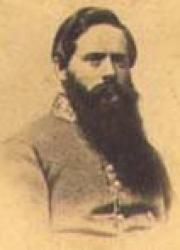
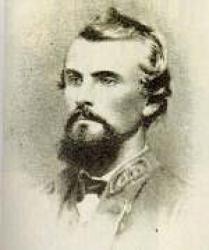
Lansford Lomax
 USA
USA- Early Life and Education
- Service on the Frontier
- Confederate Service
- Cavalry Command
- Promotion and Brigade Command
- Division Command
- Capture and Escape
- War's End
- Post-War Life
Early Life and Education
Lansford Lindsay Lomax was born on November 4, 1835, in Newport, Rhode Island, to Mann Page Lomax, an artillery major, and Elizabeth Lindsay. His mother was a descendant of Captain Lindsay, a light cavalryman during the Revolutionary War. Lomax attended schools in Richmond and Norfolk before becoming a cadet at West Point on July 1, 1852. He graduated four years later as a brevet second lieutenant and was assigned to the 2nd Cavalry Regiment.
Service on the Frontier
Lomax served on the frontier in Kansas and Nebraska before being promoted to first lieutenant on March 21, 1861. In April of that year, following Virginia's secession from the Union, Lomax resigned from the Federal army and offered his services to the Confederacy.
Confederate Service
Lomax was appointed a captain in the Virginia forces on April 28 and later served as an aide-de-camp on General Joseph E. Johnston's staff. After a series of transfers, he became Inspector General on the staff of Major General Earl Van Dorn in July 1862. Following the death of General McCulloch, Lomax was promoted to lieutenant colonel and became Inspector General for the entire Army of East Tennessee.
Cavalry Command
In February 1863, Lomax was transferred to the East and promoted to colonel. He returned to his beloved cavalry, taking command of the 11th Virginia Cavalry Regiment. As part of "Grumbling" Jones' division, he participated in raids in West Virginia and the Pennsylvania Campaign.
Promotion and Brigade Command
On July 28, 1863, Lomax was promoted to brigadier general and led a new cavalry brigade composed of the 5th, 6th, and 15th Virginia Cavalry Regiments and the 1st Maryland Cavalry Regiment. The brigade became an elite unit under Lomax's command, serving as a key strike force in Fitzhugh Lee's division during the battles of Culpeper Court House, Morton's Ford, Brandy Station II, Tod's Tavern, the Wilderness Campaign, Cold Harbor, Yellow Tavern, Ream's Station, and Trevilian Station.
Division Command
In August 1864, Lomax's exceptional bravery, composure, and tactical skill earned him a promotion to major general and command of a division comprising the cavalry brigades of Johnson, Jackson, Davidson, Imboden, and McCausland. Lomax's division performed admirably during General Early's Valley Campaign, particularly at Winchester and Tom's Brook.
Capture and Escape
On October 9, at the Battle of Woodstock, Lomax was captured by Union forces but escaped only three hours later, albeit at the cost of a cracked skull for his guard.
War's End
In March 1865, Lomax commanded the cavalry wing of Early's army and was appointed commander of the Valley District, Department of Northern Virginia. After the fall of Richmond, he regrouped his troops at Lynchburg and, following Lee's surrender, joined them with the remnants of Fitzhugh Lee's and Rosser's divisions. Lomax joined the Confederate army in North Carolina, but further resistance proved futile. His division surrendered alongside Johnston's army at Greensboro.
Post-War Life
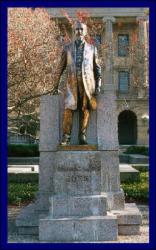
After the war, Lomax settled in Caroline County, Virginia, and worked peacefully on a farm until 1889, when he was elected president of the college at Blacksburg. He left that post five years later and devoted himself to collecting statistical data on the Civil War. Lansford Lindsay Lomax died in Washington, D.C., on May 28, 1913.