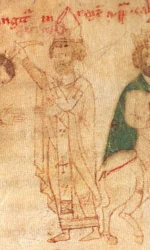
Leo IX
- From Bishop Bruno to Pope
- A Traveling Reformer
- Conflict in Southern Italy
- The Crisis with Constantinople
- Legacy
Leo IX led a major renewal of the papacy in the mid-eleventh century. A nobleman from Alsace and an experienced bishop, he traveled widely, convened church councils, and worked against the sale of church offices and the control of appointments by lay rulers. His pontificate also coincided with two major crises: the defeat of a papal army by the Normans in southern Italy and the events in Constantinople traditionally associated with the beginning of the East-West Schism.
From Bishop Bruno to Pope
Leo was born Bruno of Egisheim-Dagsburg on June 21, 1002, into a noble family in Alsace, then part of the Holy Roman Empire. He became bishop of Toul in 1026 and served there for more than two decades. As bishop, he gained a reputation for administration and religious reform.
After Pope Damasus II died in 1048, Emperor Henry III supported Bruno as a candidate. Bruno agreed to accept the papacy only if the clergy and people of Rome freely elected him. He traveled to Rome and was elected in February 1049, taking the name Leo IX. The episode reflected the tension at the heart of papal politics: imperial power could shape elections, even as reformers sought to make the church less dependent on secular rulers.
A Traveling Reformer
Leo made reform a central purpose of his pontificate. He held synods in Rome and on journeys through Italy, France, and Germany, addressing simony—the purchase or sale of church offices—and the marriage or concubinage of clergy. He sought to limit lay control over church appointments and to raise standards among the clergy.
Leo surrounded himself with reform-minded advisers, including Hildebrand, the future Pope Gregory VII, and Cardinal Humbert of Silva Candida. The pope traveled extensively rather than governing solely from Rome. His presence at councils across Europe gave reform a more coordinated and international character, helping establish the papacy as a center for church-wide policy.
Conflict in Southern Italy
The Normans had established a growing presence in southern Italy, where their conquests threatened papal territory and influence. Leo assembled an army from a coalition of German and Italian forces and confronted them at Civitate on June 18, 1053. The papal forces were defeated, and Leo was taken prisoner.
The Normans treated him with respect, but he remained in captivity for several months. His defeat showed the limits of papal military power and the danger of relying on an unstable coalition. After returning to Rome in 1054, he was seriously ill and died on April 19.
The Crisis with Constantinople
Leo’s final year also saw rising tensions between the Latin church in Rome and the Greek church in Constantinople. Disputes involved religious practice, authority, and differences in liturgy. Leo sent a delegation led by Humbert to negotiate with Patriarch Michael Cerularius.
In July 1054, after Leo had died, Humbert placed a bull of excommunication against Cerularius on the altar of Hagia Sophia. The patriarch and his synod responded by excommunicating the legates. Later generations treated this exchange as the beginning of the Great Schism between the Roman Catholic and Eastern Orthodox churches. The separation developed over centuries, however, and the events of 1054 were one episode in a much longer history of division.
Legacy
Leo IX was canonized and is remembered as a reforming pope who helped transform the papacy into a more active institution across Europe. His itinerant synods and network of advisers strengthened efforts to reform the clergy and limit lay influence over church offices. His pontificate also exposed the challenges confronting those ambitions, from military defeat in Italy to strained relations with Constantinople. The effects of his reforms continued after his death, shaping the movement that later became known as the Gregorian Reform.