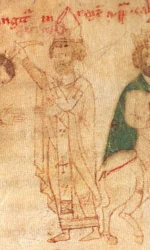
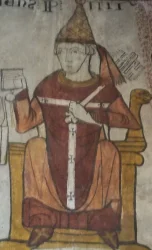
Callixtus II
Callixtus II brought the long Investiture Controversy between the papacy and the Holy Roman Empire to a negotiated settlement. A Burgundian noble and experienced churchman, he had opposed lay control over the appointment of bishops before becoming pope in 1119. His agreement with Emperor Henry V, known as the Concordat of Worms, did not end political competition between church and empire, but it established a workable division between spiritual authority and the temporal privileges attached to church office.
From Burgundy to the Papacy
Callixtus was born Guy, or Guido, into the ruling family of Burgundy. His father was Count William I of Burgundy, and his relatives included prominent European rulers and church leaders. Guy became archbishop of Vienne around 1088, giving him an influential position during the conflict over whether kings and emperors could invest bishops with their authority.
The dispute had intensified under Pope Gregory VII and Emperor Henry IV. At its center was the question of who had the right to appoint bishops and abbots, offices that carried both religious responsibilities and significant political power. In 1112, Guy convened a church council at Vienne that condemned lay investiture and excommunicated Henry V, Henry IV’s son and successor.
Guy was elected pope at Cluny in February 1119, after the death of Gelasius II, who had fled Rome during political violence. Taking the name Callixtus II, he inherited a divided church and an ongoing conflict with the emperor. A rival claimant, Gregory VIII, had been supported by Henry V, creating a schism that Callixtus had to confront alongside the broader investiture dispute.
The Concordat of Worms
Callixtus initially sought a settlement with Henry V, but negotiations broke down and the pope renewed the emperor’s excommunication at a council in Reims. In 1120, Callixtus returned to Rome and strengthened his position against Gregory VIII, who was eventually captured and imprisoned.
The decisive agreement came at Worms on September 23, 1122. Under the Concordat of Worms, Henry V gave up the right to invest bishops with the spiritual symbols of office, the ring and crosier. The pope and church retained authority over spiritual appointment and consecration. The emperor, however, kept a role in the granting of temporal rights and possessions associated with a bishopric, and episcopal elections in the empire took place in the emperor’s presence.
The settlement was a compromise rather than a complete victory for either side. It recognized that bishops held a spiritual office distinct from their political responsibilities, while acknowledging the emperor’s continuing interests in the lands and privileges attached to church positions. The agreement also varied in its practical arrangements across regions, so it did not remove every source of dispute.
The First Lateran Council
In 1123, Callixtus convened the First Lateran Council in Rome to confirm the settlement and address wider church discipline. The council, attended by bishops and abbots from across Western Europe, ratified the Concordat of Worms. Its canons also condemned simony, regulated church property, and dealt with clerical discipline and the protection of ecclesiastical rights.
The council marked a significant moment in the development of the medieval papacy. It was the first ecumenical council held in the West, according to Catholic numbering, and showed how a settlement reached between pope and emperor could be endorsed by a wider assembly of the church.
Final Years and Legacy
Callixtus II continued to strengthen papal authority in Rome and the surrounding territories after the settlement. He died in Rome on December 13, 1124, having served as pope for nearly six years. The Investiture Controversy did not vanish, and later rulers and popes continued to negotiate the limits of their authority. Yet the Concordat of Worms became an important model for managing the conflict.
Callixtus’s achievement lay in converting a prolonged struggle into a structured compromise. By distinguishing a bishop’s spiritual office from the material rights that came with it, he helped shape relations between church and state in medieval Europe. His pontificate is remembered less for personal spectacle than for a carefully negotiated settlement whose effects continued long after his death.