Leo Szilard
 USA
USABiography of Leo Szilard
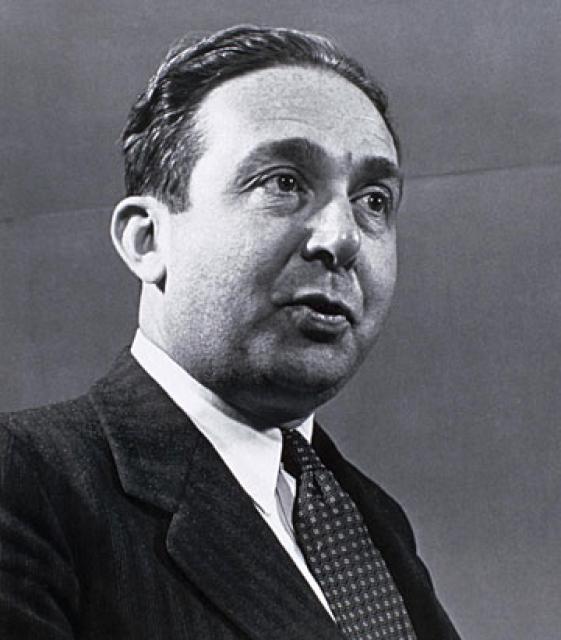
Leo Szilard was an American physicist of Hungarian origin. He was born on February 11, 1898, in Budapest, Hungary, to an engineer father. After completing his secondary education in 1916, he enrolled in the Technical University of Budapest. However, he was soon drafted into the army's artillery troops.
In 1920, Szilard moved to Germany and studied at the Technical University of Berlin, followed by the University of Berlin, where he attended lectures by Einstein, Planck, and Laue. He graduated with honors in 1922 and spent two years conducting experiments on X-ray diffraction at the Kaiser Wilhelm Institute for Chemistry. In 1924, he became an assistant to Nobel laureate Max von Laue at the Berlin Institute for Theoretical Physics, and from 1927 to 1932, he worked at the University of Berlin. During this period, he collaborated with Albert Einstein on the development of a refrigeration system, which led to the creation of the linear induction pump (Einstein-Szilard pump).
In 1928, Szilard started leading a seminar on quantum theory, together with John von Neumann. In the same year, he proposed the idea of a linear accelerator, and in 1929, he came up with the concept of the cyclotron. In 1934, he formulated the principle of self-phasing. In 1933, Szilard left Germany and moved to England. From 1935 to 1938, he worked at St. Bartholomew's Hospital in London and the Clarendon Laboratory in Oxford. During his time in England, he was one of the first to realize the possibility of a self-sustaining nuclear fission reaction. He also conducted research on chemical elements that could be used to achieve this reaction.
Anticipating the start of World War II, Szilard emigrated to the United States in 1938. He worked at Columbia University, where he continued his research in nuclear physics. He proved that secondary neutrons are released during the fission of uranium nuclei. In 1939, together with Walter Zinn, he determined the average number of secondary neutrons per fission. He also collaborated with Enrico Fermi on experiments studying water-uranium systems. Szilard deeply concerned about the German scientists' experiments on uranium nuclear fission, visited Einstein and persuaded him to write a letter to President Roosevelt, drawing the attention of the U.S. government to the possibility of using atomic energy for military purposes. Along with this letter, Szilard sent a memorandum in August 1939, elaborating on Einstein's viewpoint. Thanks to these appeals, in 1942, Roosevelt and Churchill decided to initiate all the work of British and American atomic scientists on nuclear weapons production in the United States. This marked the beginning of research at the Los Alamos Laboratory under the Manhattan Project.
In the following years, Szilard focused on improving the uranium-graphite reactor and calculating the critical mass of uranium. He proposed the use of heterogeneous systems and suggested the possibility of fast neutron fission. From 1942 to 1946, he worked at the Metallurgical Laboratory of the University of Chicago. In 1946, he became a professor at the university and conducted research in biophysics and molecular biology. In 1953, he founded the Laboratory of Molecular Biology at the University of Chicago. In 1954, he proposed the mechanism of enzyme regulation based on negative feedback, and in 1959, he developed a theory of aging, as well as methods for diagnosing leukemia and radiation therapy. He also studied cellular metabolism regulation, immunology, and the functioning of the central nervous system.
In 1945, Szilard was among the seven physicists who signed the so-called Franck Report, which warned against the use of atomic bombs. In 1961, he was elected a member of the National Academy of Sciences, and in 1959, he was awarded the Albert Einstein Peace Prize.