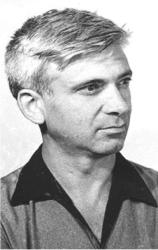
William R. Bennett
 USA
USA- William Ralph Bennett, Jr.
- Early Life and Education
- The Invention of the Gas Laser
- Pioneering Discoveries
- Outside Interests
- Legacy
- William R. Bennett, Jr., passed away on June 29, 2008.
William Ralph Bennett, Jr.
American physicist William Ralph Bennett, Jr., rose to prominence for his groundbreaking work on a unique laser that utilized gaseous substances as its active medium – the gas laser.
Early Life and Education
Bennett was born on January 30, 1930, to renowned physicist William R. Bennett, Sr. He received his Bachelor of Arts degree in physics from Princeton University, completing a thesis on spectroscopy and second-kind collisions in noble gases. Bennett later earned his doctorate from Columbia University.
The Invention of the Gas Laser
In 1962, Bennett joined the faculty of Yale University, where he would remain until his retirement in 2000. While working at Bell Laboratories in Murray Hill, New Jersey, he invented the first gas laser - the helium-neon laser. Bennett also discovered the argon ion laser, observed the formation of hole-burning effects in gas lasers, and theorized the hole-burning effect in laser oscillation.
Pioneering Discoveries
Bennett was among the first to demonstrate electron-impact excitation lasers of each of the noble gases, invented the first chemical laser, and discovered collision-pumped metal-vapor lasers. He also pioneered the use of computers in the teaching of physical science, collaborating with his daughter, Dr. Jean Bennett Maguire, to develop real-time spectral phonocardiography for detecting and classifying heart murmurs.
Outside Interests
In the physics community's exploration of strong, electromagnetic, weak, and gravitational interactions, Bennett remained skeptical of the purported discovery of a "fifth force" and dismissed the hypothesis that magnetic fields from power lines could cause cancer.
Legacy
Bennett authored eight books, published over 120 scientific papers, and obtained 12 patents throughout his career. In 1965, he was awarded the Morris N. Liebmann Memorial Award by the Institute of Electrical and Electronics Engineers.
Bennett's research in musical instrument physics led to the development of a popular course he taught at Yale. An avid musician, he studied clarinet under Russian-born composer Simeon Bellison and performed as a clarinet soloist with various amateur symphony orchestras.