Leo V
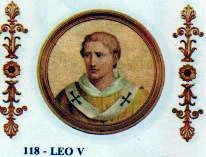
Leo V was pope for only a short time in 903, during one of the most unsettled periods in the history of the medieval papacy. The surviving record offers few details about his life or decisions. What it does show is a church leadership caught in factional struggles, where the pope’s authority could be challenged by powerful figures within Rome.
A little-known priest
Leo came from Priapi, a small settlement in the territory of Ardea south of Rome. Unlike many popes of the era, he was not part of the city’s cardinal-priesthood when he was elected. Contemporary catalogues describe him as a presbiter forensis, or an outside priest, suggesting that he was attached to a church beyond Rome itself.
The circumstances behind his election after Benedict IV are not known. The dates of his pontificate are also uncertain: records point to a reign of around a month or two, probably in the second half of 903. A writer of the time, Auxilius, praised Leo’s life and holiness and said he held the leadership of the Roman Church for thirty days. That brief notice is one of the few glimpses of the man behind the office.
A brief pontificate
Leo’s only clearly recorded act as pope was a bull granting an exemption from certain taxes to the canons of Bologna. The measure is modest, but it shows the papacy continuing its administrative and pastoral work even amid political turmoil.
That turmoil soon reached Leo himself. After little more than a month in office, he was seized by Christopher, a Roman cardinal-priest who took control of the papal office. Christopher imprisoned Leo and claimed the papacy. Later church histories generally classify Christopher as an antipope, though the politics and records of the period make the sequence of events difficult to reconstruct with confidence.
An uncertain ending
Leo’s fate is not firmly established. Some accounts say he died in prison or in a monastery, while another tradition holds that he and Christopher were executed after Sergius III returned to Rome in 904. The evidence is too thin to say exactly when or how Leo died. His disappearance from the record reflects the broader problem historians face with this era: Rome’s political upheavals left few reliable contemporary narratives.
Legacy
Leo V left almost no documentary footprint beyond the brief papacy, one surviving administrative act, and the account of his removal. His story is not one of a long program of reform or a major theological controversy. Instead, it offers a stark snapshot of the early tenth-century papacy, when political factions could overturn a pontificate almost as soon as it began.