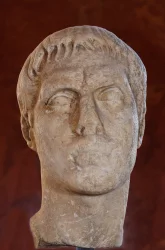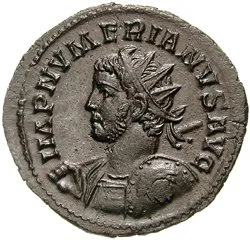
Numerian
Numerian ruled the eastern half of the Roman Empire during one of its most unsettled decades. The younger son of Emperor Carus, he accompanied his father on a campaign against the Sasanian Persian Empire and became emperor after Carus’s sudden death. Numerian’s own reign ended in a mystery that opened the way for the rise of Diocletian.
A prince on campaign
Numerian was born around the middle of the third century, the younger son of Carus and brother of Carinus. When Carus became emperor in 282, he elevated his sons to positions of authority. Carinus was given responsibility for the western provinces, while Numerian accompanied his father east on a major campaign against Persia.
The Roman army advanced deep into Persian territory and captured Ctesiphon, the Sasanian capital. Carus died suddenly in 283, while the army was still in the East. Ancient accounts disagree over the circumstances, with some attributing his death to lightning and others to illness. After his father’s death, Numerian was recognized as Augustus and began the retreat west with the army.
The emperor in the litter
Numerian reportedly suffered from an eye ailment during the journey, so he traveled in a covered litter and avoided public appearances. The arrangement allowed his officials to conceal his condition, but it also left soldiers and courtiers uncertain about what was happening. Near Nicomedia in 284, the army discovered that the emperor was dead and that his body had been hidden for several days.
The praetorian prefect Aper, who was also Numerian’s father-in-law, was accused of arranging the murder. The evidence is impossible to verify in detail, and the story comes through later Roman accounts shaped by the political transition that followed. What is clear is that Diocletian, a senior military commander, was acclaimed emperor by the assembled troops and then had Aper executed.
A brief reign and a new era
While Numerian governed in the East, his brother Carinus held power in the West. Their joint rule collapsed after Numerian’s death, and Diocletian soon faced Carinus in a civil war. Carinus was defeated in 285, leaving Diocletian in control of the empire and setting the stage for his sweeping administrative reforms.
Numerian left little evidence of his own policies. Later writers praised his education and literary talent, but those portraits are difficult to separate from the conventions of imperial biography. His importance lies chiefly in the transition his death triggered: an army returning from Persia, a concealed imperial body and a new ruler whose accession helped bring the third-century crisis toward a close.