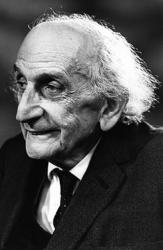
Leon Brilluien
 France
- Biography of Leon Brillouin
- Wide Range of Scientific Interests
- Contributions to Physics
- Theory of Information
Biography of Leon Brillouin
Leon Brillouin was a French physicist born on August 7, 1889, in Sevres, near Paris. He studied at the University of Munich and the University of Paris. From 1928 to 1932, he served as a professor at the University of Paris, and from 1932 to 1939, he was a professor at the College de France. In 1941, he moved to the United States, where he taught at various universities, including Columbia University.
Wide Range of Scientific Interests
Leon Brillouin had a wide range of scientific interests, including classical electrodynamics, quantum mechanics, solid state physics, radio physics, statistical physics, and information theory. Together with German physicists Gregor Wentzel and Hendrik Kramers, he developed the method of semiclassical approximation in quantum mechanics in 1926.
Contributions to Physics
Brillouin discovered the relationship between the magnetization of a paramagnet and the intensity of a magnetic field and temperature, known as the Brillouin formula. He also discovered the existence of "allowed" energy values for electrons in solids, known as Brillouin zones, and explained many physical properties of metals and semiconductors. Brillouin developed a new concept of the mechanism for the propagation of electromagnetic waves in waveguides.
Theory of Information
In the 1940s, Brillouin began to focus on the theory of information. He studied the concepts of entropy in thermodynamics and information theory, showing that obtaining information about the state of a physical system is equivalent to a corresponding decrease in its entropy. He also demonstrated that this decrease in entropy is inevitably accompanied by an increase in the entropy of another system, in accordance with the second law of thermodynamics.