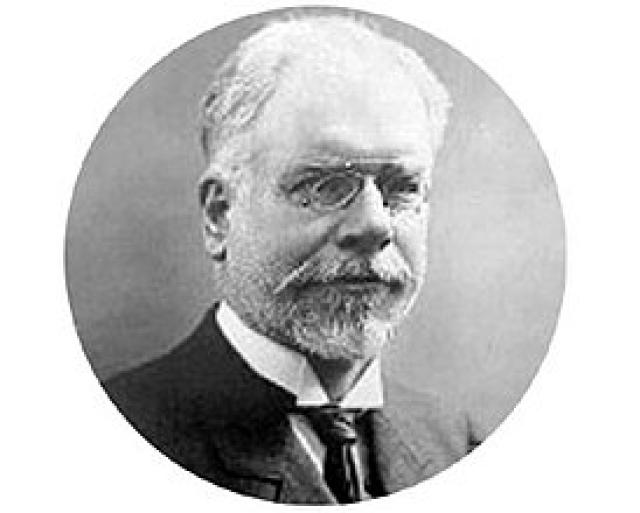
Leon Duguit
 France
- Léon Duguit: A Legal Positivist and Advocate of Social Solidarity
- The Theory of Public Service and the Social Function of Property
- Social Solidarity and the Common Good
- The Objectivity of Law and the Norm of Social Justice
- Individual as a Social Unit and the Absence of Subjective Rights
- Social Reform and Syndical Federalism
- The Legacy of Solidarism
Léon Duguit: A Legal Positivist and Advocate of Social Solidarity
A French Legal Scholar with a Sociological PerspectiveLéon Duguit, a French jurist, specialized in public law and advocated for the sociological positivist approach influenced by Durkheim and Comte. He served as a professor and later as dean at the University of Bordeaux.
The Theory of Public Service and the Social Function of Property
Duguit was a staunch supporter of the theory of public service. However, he also emphasized the social function of property rights and developed a critical analysis of the state, which he viewed as merely one possible mode of governance, a volatile entity that could eventually disappear.
Social Solidarity and the Common Good
Léon Duguit is widely considered the primary proponent of the doctrine of solidarism. Inspired by French sociologists such as Comte, Durkheim, and Bourgeois, he articulated the concept of social solidarity. In Duguit's theory, the bonds that unite people in society are ties of social solidarity. Society is divided into classes, each with a specific mission, duty, and social function toward maintaining social harmony and solidarity. These social bonds are founded on the division of labor. Collaboration among classes through division of labor would peacefully resolve the negative aspects of capitalism, without resorting to revolution.
The Objectivity of Law and the Norm of Social Justice
Duguit believed that the concept of social solidarity is recognized by individuals and gives rise to a norm of social justice: "Do nothing that undermines social justice, and do everything in your power to realize and enhance it." The social norm of solidarity serves as the foundation for all objective law. Legal norms are the "upper layer" of social norms. Individual laws, in their diversity, are only meaningful insofar as they conform to the social norm of solidarity. Duguit argued that law originates directly from social solidarity and thus stands above the state. Legal norms arise spontaneously in the context of social interactions. The legislator merely acknowledges them, not creates them. In this regard, Duguit's theory aligns with sociological jurisprudence.
Individual as a Social Unit and the Absence of Subjective Rights
For Duguit, the individual is merely a cog in the social organism. The concept of the individual is not a goal but rather a means to fulfill a specific task in the collective enterprise of social construction. In Duguit's view, there are only obligations for law. Each class has specific social functions. The state intervenes in property ownership, which should fulfill a social function. According to Duguit, property becomes socialized, it ceases to be an absolute right, and for the owner, it transforms into a social duty.
Social Reform and Syndical Federalism
Duguit advocated for social reforms in society. He expressed confidence that contemporary society was progressing toward a form of class federalism, organized into syndicates—a syndical federalism. He proposed replacing the universal individual electoral suffrage with proportional representation for parties and professional organizations. In this model, class society would be reorganized based on syndicates. Each class would unite based on profession into trade unions. Relationships between classes would be governed by contracts, not laws. The consolidation of syndicates into a federation would lead to decentralization of political power, resulting in political and legal pluralism. Power would be distributed among the different syndicates, which would assume all practical responsibilities for carrying out socio-economic and socio-political tasks. The central government's activities would be directed by a chamber composed of representatives from all the syndicates.
The Legacy of Solidarism
Many of Duguit's ideas continue to resonate today. In Norway, for instance, the duration of the working day and the minimum wage are determined by agreements between employers' and workers' organizations. The political-legal doctrine of solidarism is characterized by the following aspects:
- Ideological opposition to both individualism and socialism (communism)
- Strong opposition to the theory of class struggle (Duguit called it an "abhorrent doctrine")
- Skepticism about subjective rights, which solidarists believed alienated members of society
- Negative view of the ideals of equality and natural rights as set forth in the Declaration of the Rights of Man and of the Citizen
- Recognition of the inequality of individuals, their consequent differing positions in society, and their differentiated legal status
- Viewing the bourgeoisie and proletariat as interconnected classes, each fulfilling a socially necessary function, and obligated to collaborate harmoniously in social production
- Endorsement of private property, seen not as an individual's subjective right, but as their obligation to "freely, fully, and absolutely fulfill the social function of ownership"
- Understanding social solidarity as a "fact of mutual interdependence, which unites members of the human race due to shared needs and the division of labor"
- Believing that the recognition of solidarity generates a social norm that supersedes the state and positive (written) laws, which merely serve to implement it
- Emphasizing positive state obligations. For Duguit, the norm of solidarity is reflected in laws on universal education, healthcare, social security, labor protection, and others.
- The theory of solidarism left a significant and lasting impact on political-legal ideology and practice. In Russia, Léon Duguit's ideas found support (though not complete endorsement) from prominent legal scholars such as Pavel Ivanovich Novgorodtsev and Maksim Maksimovich Kovalevsky. Duguit's ideas on the "social functions" of law were favorably cited by A.G. Goykhbarg and other Soviet jurists during the period 1918-1920.
Unfortunately, Duguit's doctrine on syndicalist (corporatist) governance was later adopted by the Italian fascist party, the Francoist regime, and other anti-democratic movements, which undermined trust in the inherently moderate ideas of solidarism. Nevertheless, many of Duguit's concepts remain relevant to this day.