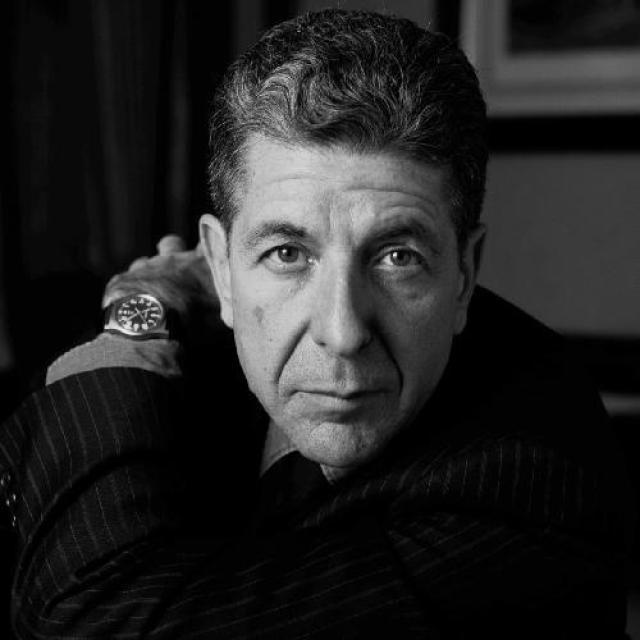
Leonard Cohen
 Canada
Biography of Leonard Cohen
Leonard Cohen, a singer, composer, and poet, first gained recognition as a poet and writer before becoming a renowned figure in literary circles and later entering the stage as a singer-songwriter. In the late 1960s, Cohen captivated audiences with his deep, velvety, and indescribably melancholic voice, becoming one of the pioneers of folk music. He never lost his fan base, even during the years he spent in a Zen Buddhist center.
Childhood and Youth
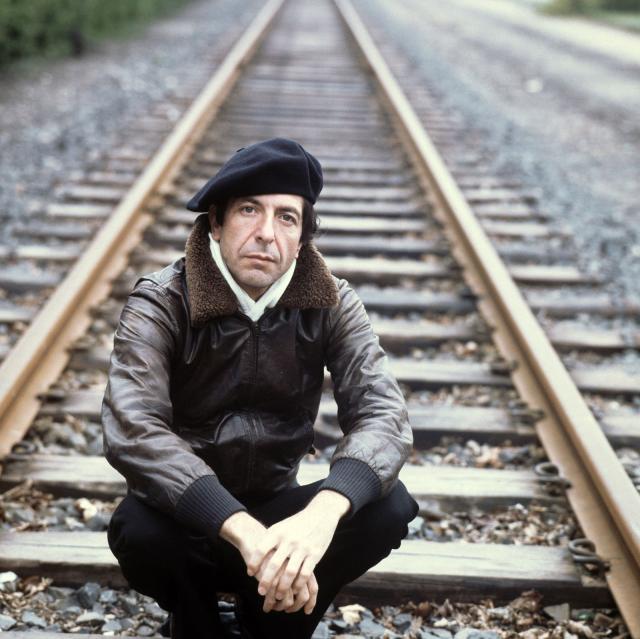
Leonard Cohen was born in 1934 in Westmount, a suburb of Montreal, in a family of successful Jewish merchants. His parents immigrated to Canada from Europe, with his father coming from Poland and his mother, Maria Klonitskaya, being born and raised in Lithuania. Despite not having any musicians or poets in his family, Leonard's creative impulses were encouraged. Until the age of 13, the son of a Montreal businessman had no musical skills. His introduction to music came about due to his first infatuation. In order to impress a girl, Leonard learned a couple of guitar chords. He had no teachers and taught himself music, driven by his soul's call. Surprisingly, within two years, he became the best guitarist in the area. The teenager occasionally performed in local cafes. It was around this time that Leonard came across a collection of poems by Federico Garcia Lorca. The young self-taught guitarist suddenly realized that music and poetry were inseparably connected, and he began composing songs. However, his first concert took place many years later. In his childhood, Cohen attended a Jewish school and continued his education at a school in Westmount. Here, he studied music, poetry, participated in theater productions, and even formed a student folk group. Leonard inherited his love of music from his mother. "She had musicality. I would take the guitar, and my mother would sing. Those songs penetrated my soul," Cohen later said about Maria Klonitskaya. Leonard often visited Saint-Laurent Boulevard, where, in a small smoky drinking establishment, art enthusiasts, spiritual and impractical people gathered in the evenings. Cohen often performed in front of them, but he didn't sing songs. He recited poetry and prose. By the late 1950s, he gained recognition in literary circles. Thanks to his father's inheritance, the young poet did not need money and devoted himself to creativity without worrying about the necessities of life. Cohen struggled with depression throughout his life. The melancholy would occasionally subside, but it always returned. Perhaps it was his chronic depression that allowed the Canadian musician and poet to create songs that have become classics of the genre. The musician had a wide circle of acquaintances, but when depression struck, he turned into a recluse. The first period of solitude in Cohen's biography occurred in the early 1960s. This was a productive time. He spent seven years on the island of Hydra and wrote two books, "The Favorite Game" and "Beautiful Losers." The public learned about Cohen as a musician in 1967.

Music
At the beginning of his literary career, Cohen gained recognition for his prose works. However, he had always been writing poetry since his youth. In 1967, the Canadian writer moved to the United States and began his musical career there. He preferred the popular folk-rock direction of those years. "Suzanne," which belongs to Cohen's early work, became a hit. The song first appeared in the performance of the 60s star Judy Collins. A few years later, Noel Harrison recorded "Suzanne." Until 1970, the poet, writer, and musician released four albums. He first performed his songs on stage in 1967 at the Newport Folk Festival. The debut was successful. The charismatic performer with a deep, low baritone voice made an unforgettable impression on the audience. Two months later, a concert took place in New York. All tickets were sold out. In the 1970s, Cohen began performing concerts, organizing tours in Europe and America. In 1979, the musician recorded the album "Recent Songs." His performance captivated the audience with its originality and simplicity. Various instruments were used in the musical accompaniment, such as guitar, gypsy violin, and mandolin. After the release of "Recent Songs," there was a five-year hiatus. When the musician returned to the stage, his work revealed philosophical and religious motifs to his fans. In 1984, Leonard Cohen recorded the song "Hallelujah." By that time, his popularity had declined somewhat, and American record companies were afraid to collaborate with Cohen. Nevertheless, the album featuring "Hallelujah" became popular in Canada and Europe. "I am amazed at the modesty with which American companies promote my records," Leonard Cohen said after another refusal. By the late 1980s, religious motifs took a back seat, and sarcasm appeared in his songs. He increasingly used a synthesizer in his concerts. The main theme in the work of the Canadian artist became social inequality, hypocrisy, and betrayal. In the mid-1990s, Cohen disappeared again. This time, he became engrossed in the philosophy of Buddhism. The desire to return to his fans forced him back onto the stage when financial troubles arose: his manager, Kelley Lynch, embezzled five million dollars from his accounts. The singer recorded the album "Ten New Songs," which included calm and melancholic compositions. Cohen was forced to retire from the stage in the 1990s due to another bout of stress. He drank three bottles of wine daily and smoked a pack of cigarettes. His voice became even lower and developed new nuances. The song "A Thousand Kisses" with its simple melody sounded extraordinary thanks to Cohen's husky voice. The music video for the song was based on the film "Malèna," starring Monica Bellucci. In 2008, Leonard Cohen recorded "Live in London" in the city of London. The title track of the album, "Dance Me to the End of Love," became a hit. It was around this time that the singer announced his long-awaited tour to his fans. Cohen visited cities in Canada and Europe. In 2010, he came to Russia for the first and last time. "Famous Blue Raincoat" and "Nevermind" are two more popular songs from his later years.
Personal Life
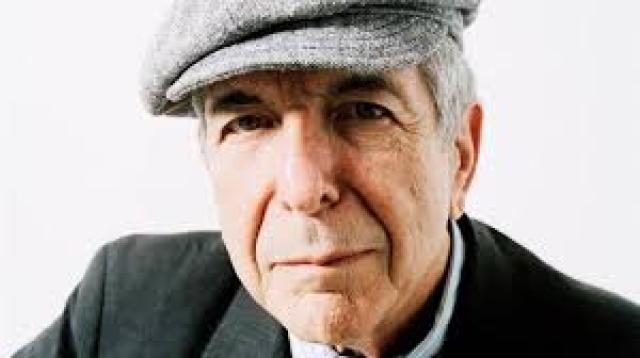
In his youth, Cohen led a bohemian lifestyle. He attempted to become involved in the family business but was unsuccessful. Moreover, his literary work only brought him a small income. However, in the late 1960s, it was not Cohen's books that were discussed but rather his eccentric behavior. In his relationships with women, the writer did not show constancy. He regularly changed lovers. Occasionally, he would consume LSD to lift his spirits. At the time, the drug was not yet banned, and poets, musicians, directors, and other creative personalities experimented with it. In the 1960s, Cohen had a romantic relationship with Marianne Ihlen, whom he dedicated one of his early songs to. Then, another woman appeared in the musician's life, Suzanne Elrod, who became his wife. Contrary to popular belief, the hit song "Suzanne" is dedicated to another woman. Cohen and Elrod separated in 1979. The musician had two children, Lorca and Adam. His daughter, named after his beloved poet, became a photographer. His son is a musician and the lead vocalist of the band Low Millions. In the 1980s, Cohen had a love affair with photographer Dominique Issermann. The Frenchwoman participated in the filming of his music videos. Dominique's image adorns the cover of "Stranger Music," a book by Cohen published in 1993. The last woman in the musician's life was Rebecca De Mornay.
Death
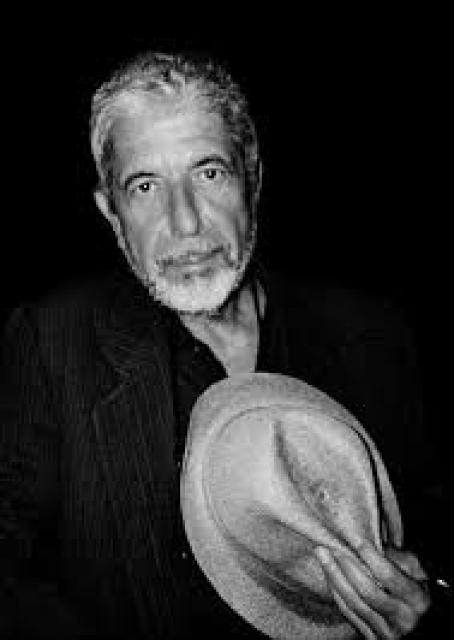
In October 2016, Leonard Cohen released his final album, "You Want It Darker." The Canadian musician died from leukemia three weeks after the album's release. He was buried in his hometown. Two months after his death, a concert dedicated to his work took place in Montreal.
Discography
- 1967 – Songs of Leonard Cohen
- 1974 – New Skin for the Old Ceremony
- 1977 – Death of a Ladies' Man
- 1984 – Various Positions
- 1992 – The Future
- 2001 – Ten New Songs
- 2009 – Live in London
- 2010 – Songs from the Road
- 2014 – Popular Problems
- 2016 – You Want It Darker