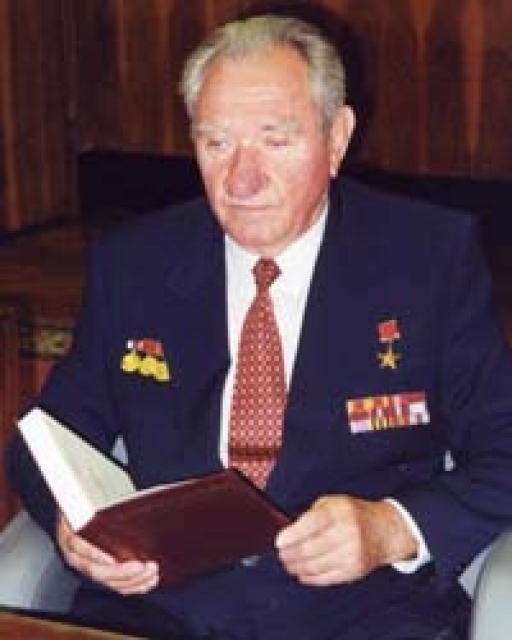
Leonid Gusev
 Russia
- Leonid Ivanovich Gusev: A Visionary in Space Engineering
- Early Life and Education
- Military Service and Wartime Heroism
- Post-War Career
- Directorial Leadership
- Return to NII-885 and Scientific Achievements
- Groundbreaking Innovations in Space Technology
- Academic and Scholarly Pursuits
- Awards and Recognition
- Legacy and Inspiration
Leonid Ivanovich Gusev: A Visionary in Space Engineering
Born on April 3, 1922, in a humble village in the Moscow Oblast, Leonid Ivanovich Gusev embarked on a remarkable journey that would transform the realm of space technology.
Early Life and Education
Gusev's childhood was marked by modest beginnings in a large peasant family. His formative years were shaped by the challenges of a simple rural existence. In 1930, he enrolled in a local school, but his formal education was cut short when his family relocated to Moscow in search of better opportunities.
Military Service and Wartime Heroism
Gusev's life took a dramatic turn with the outbreak of World War II. He served as a communications officer on the Western and Belorussian Fronts, showcasing exceptional courage and ingenuity. For his actions in retrieving a radio transmitter under perilous conditions, he was awarded the prestigious "For Courage" medal.
Post-War Career
After returning from the war, Gusev embarked on a multifaceted career. He worked as a radio club manager, pursued engineering at the Moscow Electrotechnical Institute of Communications, and joined the prestigious NII-885 research institute, where he dedicated himself to the nascent field of rocketry.
Directorial Leadership
Gusev's exceptional organizational skills and technical expertise culminated in his appointment as the Director of NII-695 in 1959. Under his stewardship, the institute transformed into a powerhouse of space innovation, playing a pivotal role in the development of communication systems for the "Vostok-1" spacecraft, which carried Yuri Gagarin into orbit. Gusev's leadership earned him the coveted title of Hero of Socialist Labor.
Return to NII-885 and Scientific Achievements
Returning to NII-885 in 1965, Gusev ushered in an era of scientific advancements and technological innovation. He implemented a range of initiatives, including the automation of design and production processes, which fostered a culture of creativity and excellence.
Groundbreaking Innovations in Space Technology
Gusev's contributions to space engineering were profound. He spearheaded the development of radiotelemetry systems, trajectory measurement complexes, and communication networks that enabled the successful exploration of the Moon, Mars, and Venus. His work revolutionized space navigation, satellite communication, and early warning systems for natural disasters.
Academic and Scholarly Pursuits
Beyond his administrative roles, Gusev was an esteemed scholar and academician. He authored over 170 scientific papers and held the position of Professor at the Moscow Institute of Radio Engineering and Automation (MIREA). He was elected to several prestigious academies, both domestic and international.
Awards and Recognition
Gusev's exceptional contributions to science and space exploration were recognized with numerous awards and accolades. He was bestowed with the Lenin Prize, the USSR State Prize, and the Russian Federation State Prize.
Legacy and Inspiration
Leonid Ivanovich Gusev's legacy is etched into the annals of space exploration. His unwavering belief in Soviet engineering, coupled with his scientific brilliance and organizational acumen, propelled him to the forefront of the field. Gusev's visionary leadership and unwavering commitment to innovation continue to inspire generations of scientists and engineers striving to push the boundaries of human knowledge beyond Earth's atmosphere.


