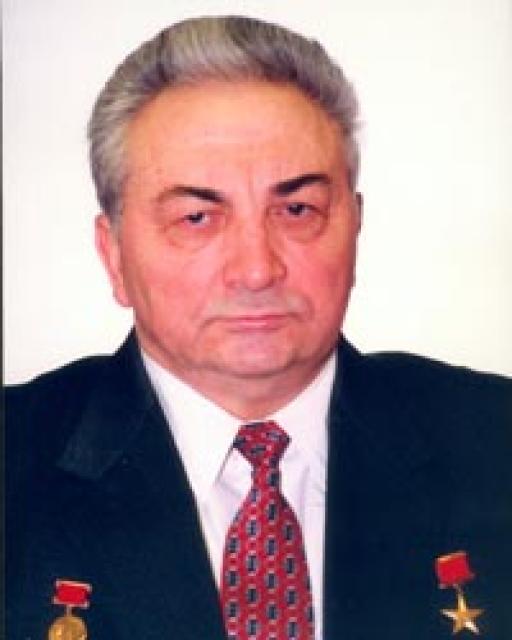
Vitaliy Doguzhev
 Russia
- Early Life and Education
- Early Career in Rocket Science
- Director of Ust-Katav Wagon-Building Plant
- Return to Zlatooust Machine-Building Plant
- Deputy Minister and Minister of General Machine Building
- Role in the Energia-Buran Program
- Post-Soviet Career
Early Life and Education
Vasily Khusseynovich Doguzhievwas born on December 25, 1935, in Yenakiyevo, Donetsk Oblast, Ukraine. His father, a descendant of an ancient Circassian family, worked as an engineer and manager. His mother came from a mining family.
In 1953, after graduating high school, Doguzhiev enrolled in the Special Faculty of Dnipropetrovsk University. He excelled academically and was an active member of the university's Komsomol, the youth wing of the Communist Party. During his student years, he participated in various extracurricular activities, including drama, choir, and sports.
Early Career in Rocket Science
Upon graduating in 1958 with a specialization in "Rocket Engines," Doguzhiev moved to Zlatooust, Chelyabinsk Oblast, Russia. He initially worked as a technologist in the mechanical assembly workshop of the Zlatooust Machine-Building Plant, which produced missiles for submarines.
Recognizing his potential, the plant's management invited Doguzhiev to lead a newly established manufacturing unit for missile motor components. He excelled in this role, modernizing the facility and increasing production efficiency.
Director of Ust-Katav Wagon-Building Plant
In 1967, at the age of 31, Doguzhiev was appointed Director of the Ust-Katav Wagon-Building Plant. Under his leadership, the plant significantly expanded its operations, introduced new production technologies, and invested heavily in social infrastructure, including housing, healthcare, and transportation. Doguzhiev's innovative approach earned him recognition and awards for his contributions to the defense industry.
Return to Zlatooust Machine-Building Plant
In 1976, Doguzhiev was appointed Director of the Zlatooust Machine-Building Plant, which he had previously worked for. At the time, the plant was responsible for developing and producing the Soviet Union's first intercontinental ballistic missile system with a multiple-warhead design.
Doguzhiev's leadership proved crucial in successfully completing this complex project. He implemented rigorous quality control measures, mobilized the workforce, and secured significant funding for modernization and infrastructure upgrades.
Deputy Minister and Minister of General Machine Building
In 1983, Doguzhiev was appointed Deputy Minister of General Machine Building, responsible for all aspects of rocket production within the industry. In 1988, he was promoted to the position of Minister, overseeing the entire spectrum of rocket and space technology development.
Role in the Energia-Buran Program
During his tenure as Minister, Doguzhiev played a pivotal role in the Energia-Buran program, which aimed to create a reusable space shuttle system. Despite initial challenges and a tense atmosphere, he pushed for the successful launch of the Energia-Buran mission on November 15, 1988. This achievement demonstrated the Soviet Union's technological prowess and solidified Doguzhiev's legacy.
Post-Soviet Career
After the dissolution of the Soviet Union, Doguzhiev continued his work in the space industry. He served as General Director of the Military-Industrial Investment Company and founded the First National Pension Fund, which has been operating successfully since its inception in 1992.
Throughout his career, Doguzhiev has received numerous awards and honors, including the title of Hero of Socialist Labor, the State Prize of the USSR, and membership in the Russian Academy of Cosmonautics named after K.E. Tsiolkovsky. His contributions to the development of rocket technology and the space program have left an enduring mark on the history of Soviet and Russian science and industry.


