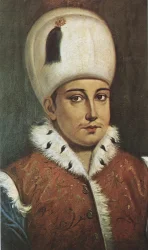
Leonidas I
Leonidas I was a king of Sparta whose name became inseparable from the Greek defense at Thermopylae in 480 BCE. Facing the invasion of the Persian king Xerxes, he led a force that held the narrow pass for several days before being surrounded and killed. The stand ended in defeat, but it became a lasting emblem of resistance and sacrifice in Greek memory.
A Spartan king
Leonidas belonged to the Agiad royal house, one of Sparta’s two hereditary dynasties. He became king around 490 BCE after the death of his half-brother Cleomenes I. Leonidas married Cleomenes’ daughter Gorgo, and their son Pleistarchus later inherited the throne. Sparta’s kings shared power with one another and with civic institutions, so Leonidas ruled within a political system that distributed authority among several offices.
Little is securely known about his life before the Persian invasion. The chief early narrative source is Herodotus, who wrote within living memory of the wars but also included speeches, traditions, and dramatic episodes that cannot all be independently confirmed.
Thermopylae
In 480 BCE, Xerxes led a vast Persian army into Greece. A coalition of Greek city-states chose the narrow coastal pass at Thermopylae as a defensive position while the fleet fought nearby at Artemisium. Leonidas commanded the Greek land force. He initially brought 300 Spartan warriors, selected, according to Herodotus, from men who had living sons, alongside contingents from other Greek communities. The total force defending the pass was several thousand.
The Greeks used the narrow terrain to blunt the Persian numerical advantage and held their position for several days. Their position was then compromised when a local man named Ephialtes showed the Persians a route around the pass. Leonidas dismissed or sent away much of the allied force, while a smaller group remained to cover the retreat and continue the fight. The final defenders included the Spartans, Thespians, and Thebans; accounts differ on the exact details of their last stand.
Leonidas was killed, and the Persians took the pass. Greek tradition later emphasized the courage of the defenders and the time they bought for the wider resistance. The battle did not stop the Persian advance, but it became an important episode in the Greek coalition’s struggle, which later culminated in Persian defeats at Salamis and Plataea.
Memory and legacy
Stories about Leonidas and the 300 Spartans have been retold for centuries, often simplifying the much broader Greek participation at Thermopylae. The battle’s remembered symbolism—discipline, defiance, and willingness to die for one’s community—has sometimes overshadowed its military outcome and the role of the other Greek contingents.
Herodotus also preserves sayings attributed to Leonidas and his wife Gorgo, but these anecdotes are best treated as part of the tradition through which later Greeks interpreted the war. Leonidas’s historical significance rests most securely on his command at Thermopylae and his death there. His stand helped make the Spartan king a lasting figure in accounts of ancient Greek resistance to invasion.