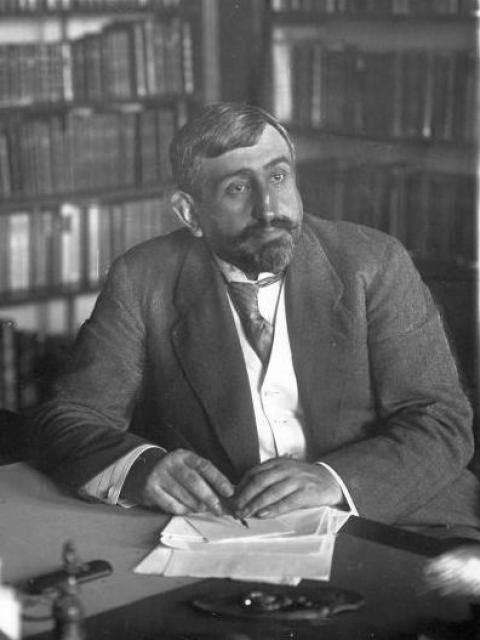
Lev Kasso
 France
Lev Kasso was a French-born jurist who rose to become one of the most consequential—and controversial—education ministers of late imperial Russia. A professor of civil law before entering government, he served as minister of public education from 1910 until his death in 1914. His tenure was marked by sharp conflict with universities, as his efforts to enforce state authority over higher education helped trigger the 1911 Moscow University crisis.
Kasso was born in Paris in June 1865 into a noble family with roots in Bessarabia. His education took him through leading European institutions, including law studies in Paris, Heidelberg and Berlin. Because he lacked the Russian secondary-school certificate normally required for state service, he later completed examinations in Russia, earning advanced degrees in civil law. His academic work focused on private law, including inheritance and the legal concept of pledges.
A respected academic before government
Kasso began teaching law at Kharkov University and in 1899 joined the faculty of Moscow University, where he became a professor of civil law and civil procedure. Alongside his university work, he served as director of the Katkov Lyceum in Moscow. His scholarly reputation and administrative experience helped propel him into public office at a time when the government was debating the future shape and control of Russian higher education.
In 1910, Prime Minister Pyotr Stolypin selected Kasso to lead the education ministry after a change in the government’s approach to universities. The ministry was caught between competing demands: officials wanted education to serve state needs and suppress student unrest, while professors argued that universities required meaningful academic autonomy. Kasso took a conservative position, arguing that the existing university statute could remain in force and that the government must maintain control over institutions it funded.
The 1911 university crisis
The conflict became acute in early 1911, amid renewed student demonstrations. Ministry rules restricted student gatherings and gave city authorities greater power to intervene in university affairs. At Moscow University, police entered the campus to enforce the restrictions. The rector and senior university administrators resigned, and roughly 130 professors, lecturers and other staff followed in protest.
The episode, often remembered as the “Kasso affair,” became a turning point in relations between the government and the academic community. It damaged the ministry’s standing among professors and liberal public opinion, while failing to end student activism. Kasso’s defenders viewed the measures as an attempt to restore order and keep institutions functioning; opponents saw them as an assault on university autonomy. The dispute unfolded against a broader political backdrop in which the imperial government was increasingly at odds with educated society.
Kasso’s approach also shaped the wider debate over higher education. A reform statute proposed by his predecessor was withdrawn, and proposals to expand universities faced resistance from the ministry. At the same time, education in Russia continued to grow through private philanthropy and institutions supported by other ministries. The argument was not simply whether to educate more people, but who should direct universities and what purpose they should serve.
Scholarship and lasting controversy
Despite his political reputation, Kasso remained a lawyer and scholar. His publications addressed civil law and the history of legal institutions, including Bessarabian law. His academic work has often been overshadowed by the political controversies of his ministerial years, but it formed the professional foundation on which he built his career.
Kasso died in Saint Petersburg in December 1914, aged 49, while still in office. He left a complicated legacy: a serious legal scholar and experienced administrator whose ministerial policies placed state control ahead of academic self-government. The Moscow University crisis made his name a lasting symbol of the struggle over education and civil liberties in the final years of the Russian Empire.