Libius Severus
- Origins and Accession
- A Divided Western Empire
- Government and Relations with Ricimer
- Death and Succession
- Legacy
Libius Severus was Western Roman emperor from 461 until his death in 465, during the empire’s final decades in the West. A senator from southern Italy, he was elevated by the powerful general Ricimer after the previous emperor, Majorian, was deposed and killed. Severus held the imperial title, but his authority was constrained by Ricimer’s military dominance and by the shrinking reach of the western government. His reign reflects how the imperial office endured even as the empire’s ability to command its provinces and armies weakened.
Origins and Accession
Severus was probably from Lucania in southern Italy. Little is known about his life before he became emperor, and his exact birth date is not recorded. After Ricimer removed Majorian in 461, the western throne remained vacant for several months. On November 19, 461, Severus was proclaimed emperor at Ravenna, with Ricimer’s support.
The choice followed a familiar late Roman pattern: the emperor supplied legitimacy, while a senior commander controlled the army and much of practical politics. Severus was not simply a powerless figure, however. His reign involved the Senate, the imperial court, and the formal mechanisms of government. Yet he lacked the military independence needed to reunite the divided western territories or challenge Ricimer’s position.
A Divided Western Empire
By the time Severus took power, the western emperor’s authority was largely concentrated in Italy. Gaul was beyond effective control from Ravenna, and the general Aegidius governed a separate power base there after breaking with Ricimer. Marcellinus maintained his own authority in Dalmatia. In North Africa, the Vandal king Gaiseric controlled the former Roman provinces and posed a continuing threat to Italy and the western Mediterranean.
The Eastern Roman emperor Leo I did not recognize Severus as the legitimate ruler of the West. This refusal weakened Severus’s standing and made cooperation between the courts difficult. The lack of recognition also complicated efforts to mount a coordinated response to the Vandals. Later chroniclers characterized the emperor as an usurper because he had taken power without Leo’s approval, though he was accepted by the Roman Senate and ruled from the western imperial court.
Government and Relations with Ricimer
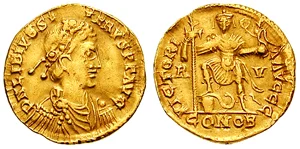
Few major reforms or military campaigns are associated with Severus. Surviving legal enactments from his reign were issued in his name and Leo’s, reflecting efforts to maintain the appearance of continuity between the eastern and western governments despite the political split. Coins bearing Severus’s image were minted in Italy, providing a public reminder of imperial authority.
Ricimer remained the decisive power behind the throne. His influence was built on control of the army and his ability to appoint and remove emperors. Severus’s position therefore rested on a political arrangement that was stable enough to last several years but too narrow to restore the western empire’s former reach. The emperor’s limited role should be understood against that structural weakness, rather than treated as evidence that he personally controlled every decision attributed to his government.
Death and Succession
Severus died in 465. The exact date is uncertain in the sources, and accounts disagree about the circumstances. A later chronicle repeated a report that Ricimer poisoned him, but the more contemporary poet and official Sidonius Apollinaris described his death as natural. The poisoning story is therefore a possibility reported in later tradition, not an established fact.
No new western emperor was immediately appointed. Ricimer governed without one for roughly a year and a half, until the eastern court and western political leaders agreed on Anthemius, who arrived in Italy in 467. The interval underlined the weakness of the imperial office and Ricimer’s ability to exercise power without the title.
Legacy
Libius Severus was one of several short-reigning emperors whose authority depended on military strongmen in the late Western Empire. His reign did not reverse the loss of territory or the division of military command, but it preserved the formal imperial structure in Italy during a turbulent period. His story is also a reminder that the end of the Western Roman Empire was not a single sudden event: its institutions continued under emperors whose actual power varied sharply, until military and political structures changed beyond repair.