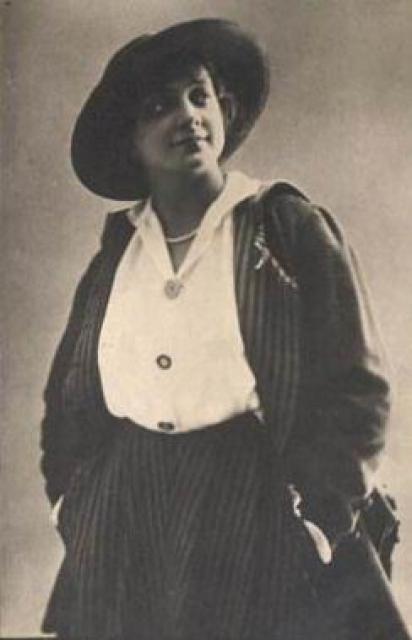
Lidiya Rudnina
 France
- Biography of Lidia Ryndina
- Early Career and Film Beginnings
- Interest in Mysticism and Occultism
- Involvement in Martinism and Correspondence with Papus
- Spiritual Interests in Emigration
- Connection with Papus and Death
Biography of Lidia Ryndina
Lidia Dmitrievna Ryndina was a theater and film actress, as well as a writer. She began her career as a dramatic artist in Kiev, under the guidance of Sinelnikov. She then spent two years at the Korsh Theater in Moscow. Afterward, she worked for eight years under Nezlobin, performing in plays such as "The Emerald Spider" by Auslender, "The Red Inn" and "Psiasha" by Yuri Belyaev, "King Dagobert" by Rivuar (translated by Teffi), and "Orlenok" and "Princess of Dreams" by Rostan. She was an actress at the Alexandrinsky Theater, as well as the theaters of K. N. Nezlobin and F. A. Korsh, before transitioning to become a film actress and a star of silent cinema. During the height of silent Russian cinema, the biggest stars were Vera Kholodnaya, Vera Krali, and Lidia Ryndina.
Early Career and Film Beginnings
In 1913, Lidia Ryndina started appearing in films, first working with Yermoliev, where her partners were Mozzhukhin and Strizhevsky, and later at the Khanzhonkov studio, where she acted alongside Polonsky and Radin in various films. According to Khanzhonkov in his book "The First Years of Russian Cinema," Ryndina opened a studio to train aspiring film actors and quickly gained numerous students eager to learn the secrets of the screen.
Interest in Mysticism and Occultism
Poet Igor Severyanin dedicated several poems to Lidia Ryndina, such as "Rocking the Dreamer" (1911) and "Rondo" (1914). According to Y.K. Terapiano, Ryndina was always interested in mysticism and occultism. Before leaving Russia, she was associated with the esoteric Order of Martinists and personally acquainted with the famous occultist Papus. Despite her busy career as an actress in the theater and later in cinema, Ryndina always found time to delve into spiritual matters and esotericism. Her apartment, shared with her husband, poet Sergei Krechetov (S.A. Sokolov), who owned the publishing house "Grif," was frequented by members of the Moscow literary circle, including Andrei Bely, Valery Bryusov, and others. During her time in Moscow in 1913, she befriended Indian musician and mystic Inayat Khan, as she writes in her memoirs.
Involvement in Martinism and Correspondence with Papus
Andrei Bely, who was interested in Martinism at the time (later anthroposophy), introduced Lidia Ryndina and Sergei Krechetov to it. In Moscow, there still existed an old center of Russian Martinism that had survived since the time of Nikolay Novikov and Lopukhin, famous figures of the Russian Enlightenment during Catherine the Great's reign. According to V.S. Brachev in his book "Masons in Russia - From Peter I to Our Days," actress L.D. Ryndina, the wife of the well-known political Mason S.A. Sokolov, was an active member of the "St. John" Lodge in Moscow. The Martinists in Moscow met privately in the apartments of their members. The apartment of S. Krechetov and L. Ryndina in Moscow, located in Pimenovsky Lane, served as a meeting place for years.
Spiritual Interests in Emigration
Lidia Ryndina maintained her interest in spiritual matters during her time in emigration. She continued to follow new books in the field and kept in touch with various occultists in France and dispersed Russian mystics worldwide. She also corresponded with the journal "Occultism and Yoga," published by Dr. Aseev.
Connection with Papus and Death
Even before the revolution, during her trips to Paris, Lidia Ryndina met the famous Dr. Papus (Gerard Encausse), the leader of the French Martinist movement and the author of numerous books on occult subjects. In 1901, Dr. Papus was presented to the Russian Imperial Court by Grand Duke Nikolai Nikolaevich, and he visited Russia three more times in 1901, 1905, and 1906, at the invitation of Emperor Nicholas II. He founded his Martinist lodge in St. Petersburg, which, for a time, included members such as Emperor Nicholas II and Empress Alexandra Feodorovna, Grand Duke Nikolai Nikolaevich and his wife, and other members of the imperial family. Dr. Papus held Lidia Ryndina in high regard and gave her special initiation into the inner circle of his organization.
In 1919, Lidia Ryndina acted in a film at Khanzhonkov's studio in Crimea. She then traveled to Constantinople and Vienna, where she appeared in two films. In 1922, she moved to Berlin, where she found a new role playing various beauties in the artistic cabaret "Blue Bird." She performed in musical plays such as "The Princess Who Couldn't Laugh," "The King Ordered the Drum to Beat," "Three Young Soldiers Went to War," and others. During World War II, she fled burning Berlin and sought refuge in Karlovy Vary. After the war, she returned to Germany and traveled extensively with her troupe, performing in prisoner-of-war camps. She later moved to Paris, where several of her plays, including Ibsen's "Ghosts," were staged.
Lidia Dmitrievna was not only an actress but also a writer and journalist. In Moscow, she published her first book, a translation of Marcel Schwob's stories. In Berlin, her book "Favorites of Fate" was published, followed by the comical detective novel "Living Masks" in Riga. She wrote several short stories, all of which were published in various periodicals. In her later years, she worked as a correspondent for the newspaper "Novaia Zaria" in San Francisco.
Lidia Ryndina was laid to rest in the Russian cemetery of Sainte-Genevieve-des-Bois.


