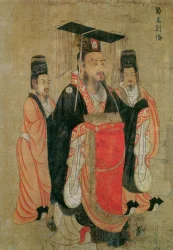
Liu Bei
- From Local Official to Warlord
- An Alliance and a New Base
- Defeat at Yiling
- A Legacy Between History and Legend
Liu Bei rose from modest beginnings to become one of the leading contenders for power as the Han dynasty disintegrated. Remembered as the founding emperor of Shu Han, he built a coalition through years of shifting alliances and warfare, then claimed to continue the Han imperial line. His rise was remarkable, but the state he established faced powerful rivals and his own final campaign ended in defeat.
From Local Official to Warlord
Liu Bei was born in 161 in Zhuo Commandery, in what is now Hebei Province. Later accounts traced his family to the Han imperial house, though the connection was distant. His family had little wealth, and he was raised by his mother. As rebellion and unrest spread late in the second century, Liu Bei joined local forces mobilized to suppress the Yellow Turban uprising. He gained a reputation as a capable leader, but for years lacked a stable territorial base.
The collapse of central authority forced Liu Bei to navigate a changing landscape of regional commanders. He served and allied with different leaders, including the warlord Gongsun Zan, while building a following of his own. His fortunes often reversed: he captured territory, lost it to stronger rivals, and sought new alliances. The historical record presents a pragmatic political and military figure whose persistence mattered as much as any single victory.
An Alliance and a New Base
In 208, Liu Bei joined forces with Sun Quan against Cao Cao, whose army had moved south. Their coalition defeated Cao at the Battle of Red Cliffs, halting his advance into the Yangtze region. The victory helped establish a balance among rival powers in the south, although the alliance with Sun Quan was uneasy and later broke down.
Liu Bei eventually secured control of Yi Province, centered on present-day Sichuan, and made Chengdu his base. In 219 he declared himself King of Hanzhong, openly challenging Cao Cao’s influence. The following year, Cao Pi deposed the last Han emperor and founded the state of Wei. Liu Bei responded in 221 by proclaiming himself emperor of Han, claiming that his regime continued the legitimate dynasty. Historians later called his state Shu Han to distinguish it from other states claiming the Han name.
Defeat at Yiling
Liu Bei’s last major campaign was against Sun Quan’s state of Wu. The conflict followed Wu’s seizure of Jing Province and the execution of Liu Bei’s ally Guan Yu in 219. In 222, Liu led a large expedition east to recover the territory and avenge the loss. Wu’s general Lu Xun drew the Shu forces into a prolonged campaign and defeated them at Yiling, also known as Xiaoting. The defeat cost Liu Bei many troops and weakened his position.
Liu retreated to Baidi, near present-day Fengjie, where he became ill. In 223 he died, having entrusted his son and successor Liu Shan to the care of his chancellor Zhuge Liang. The arrangement helped preserve the young Shu Han court, though Liu’s state remained smaller and less well resourced than Wei.
A Legacy Between History and Legend
Later popular culture turned Liu Bei into an emblem of benevolent leadership and loyalty, especially through the celebrated novel Romance of the Three Kingdoms. That work reshaped many episodes and added legendary details, so its portrait differs from the historical record. The historical Liu Bei was a resilient coalition-builder whose claim to Han legitimacy helped his new state command loyalty. His career illustrates how, in a fractured empire, political legitimacy and military strength were intertwined.