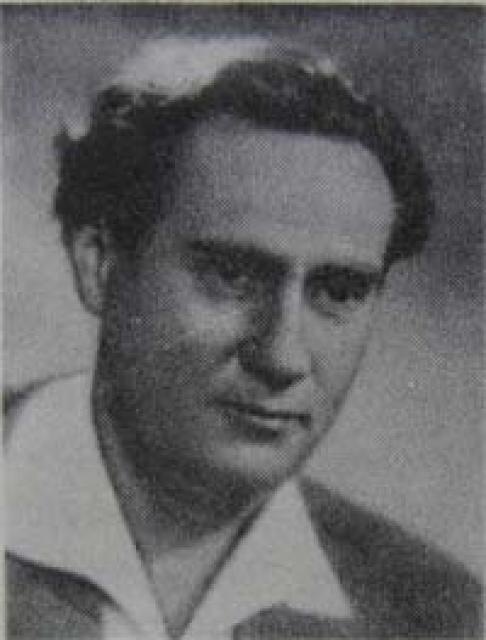
Liviu Deleanu
- Early Life and Literary Beginnings
- Founding "Prospect" and Early Poetry
- Contribution to Moldovan and Russian Literature
- Post-War Poetry and Recognition
Early Life and Literary Beginnings
Liviu Deleanu was born in Iași, Romania, in 1911. His father, Shmil (Semy) Cligman, was a poet who encouraged his son's literary endeavors. Deleanu attended Hebrew school and Romanian gymnasium in Iași. He began working as a lithographer and proofreader at a printing house at age 11, immersing himself in the literary world at a young age.
Founding "Prospect" and Early Poetry
At age 16, Deleanu became a staff writer for the journal "Vitrina Literară." He initially used the pseudonyms "Cliglon" and "C.L. Deleanu." In 1927, he published his first poetry collection, "Oglinzi fermecate" (Enchanted Mirrors), under his own name.
Together with poet Virgil Gheorghiu, Deleanu founded his own journal, "Prospect," in 1928. This modernist publication featured poetry and prose from Deleanu, Gheorghiu, and other emerging writers.
Contribution to Moldovan and Russian Literature
After Bessarabia became part of the USSR, Deleanu moved to Chișinău and became a prominent figure in the city's literary scene. He translated the Soviet anthem into Moldovan and later translated Russian poetry during World War II, including works by Krylov, Pushkin, Lermontov, and Tvardovsky.
Deleanu also wrote original poetry, including "Balada lui Kotovschii" and "Balada urii." He worked as a literary editor for the ensemble "Doina" from 1943.
Post-War Poetry and Recognition
In the postwar years, Deleanu published numerous poetry collections, including "Mi-i drag să meșteresc" (I Love to Craft, 1953), "Poezii și poeme" (Poems and Verses, 1954), and "Stihuri alese" (Selected Poems, 1958). He also wrote children's books, such as "Poezii pentru copii" (Poems for Children, 1947) and "Licurici: stihuri pentru mici" (Firefly: Poems for Little Ones, 1961).
Deleanu received widespread recognition for his poetic legacy. His work has been reissued and translated into multiple languages. He is considered a classic of postwar Moldovan literature.