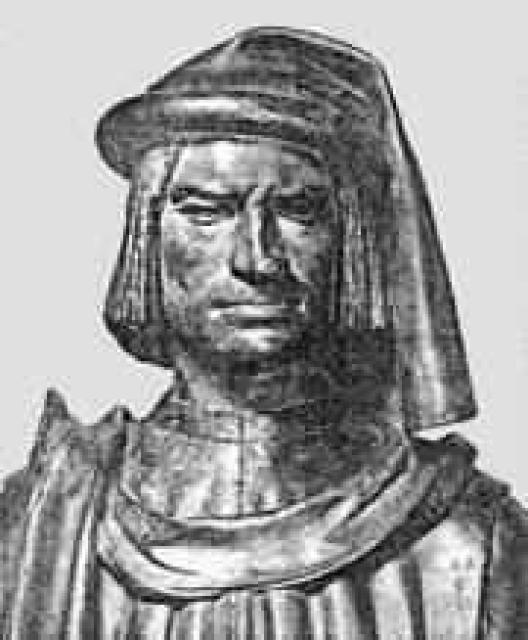
Lorenzo Medichi
 Italy
Italy- Biography of Lorenzo de' Medici (the Magnificent)
- Early Life and Education
- Political Career and Patronage
- Challenges and Achievements
Biography of Lorenzo de' Medici (the Magnificent)
Lorenzo de' Medici (the Magnificent) was an Italian writer and political figure, who ruled Florence from 1469. He was a patron of artists and writers and wrote brilliantly in various styles and genres. He ensured the preservation of his power through various means, including an extensive network of personal connections within and outside of Florence, as well as employing strategies to eliminate political opponents during elections.
Early Life and Education
Lorenzo de' Medici was born on January 1, 1449, in Florence and died on April 8, 1492, in Careggi, Florence. He was the grandson of Cosimo de' Medici the Elder. The period of Lorenzo the Magnificent's reign is associated with the highest flowering of the Renaissance culture in Florence. During his childhood, Lorenzo was educated by his mother, Lucrezia Tornabuoni, and later by renowned humanists such as Johannes Argyropoulos, Cristoforo Landino, and Marsilio Ficino, who taught him classical languages, philosophy, and poetry.
Political Career and Patronage
From an early age, Lorenzo carried out important diplomatic missions and participated in state affairs. In July 1469, he married Clarice Orsini, a noblewoman from Rome. Similar to his grandfather, Lorenzo never held any key official positions and the republican façade of Florentine governance saw little change during his time. The epithet "the Magnificent" is a testament to the fact that his power was largely based on the popularity he gained through lavish spending from his own and public funds on luxurious buildings, works of art, and grand celebrations.
During his rule, endless carnivals, masquerades, knightly tournaments, theatrical performances, and other events took place. A lover of literature himself, Lorenzo was the author of poetic works and scholarly treatises. Like his grandfather, he supported Marsilio Ficino, the head of the Platonic Academy, and poets such as Angelo Poliziano and Luigi Pulci. He hosted prominent humanists such as Landino, Argyropoulos, Francesco Filelfo, Bernardo Bembo, Ercole Barbaro, Giovanni Pico della Mirandola, and Johannes Reuchlin. He also supported artists such as Sandro Botticelli, Filippino Lippi, Andrea Verrocchio, Pollaiuolo, Ghirlandaio, Giuliano da Sangallo, and a young Michelangelo. In accordance with family tradition, Lorenzo expanded the library (later named Laurentiana after him), acquiring books from all over Europe. He also collected ancient and contemporary sculptures, cameos, coins, and paintings.
Challenges and Achievements
Lorenzo displayed remarkable diplomatic talent and became one of the creators of Italian balance of power, skillfully playing on contradictions between Venice, Milan, the Kingdom of Naples, and the Pope. In 1479, he embarked on a bold visit to his sworn enemy, Ferdinand of Naples, and achieved favorable conditions for ending the war with him and the Pope, which greatly enhanced his authority in Florence. He expanded Florentine territories by annexing the fortresses of Pietrasanta, Sarzana, and Piancaldoli.
Lorenzo's commercial activities, however, were unsuccessful. In order to cover the increasing expenses of the commune, including popular festivities and amusements, he imposed new taxes, carried out compulsory state loans, and resorted to coin debasement. Popular discontent, caused by the growing financial burden, eventually led to the expulsion of Lorenzo's son and successor, Piero, by the Florentines in November 1494.