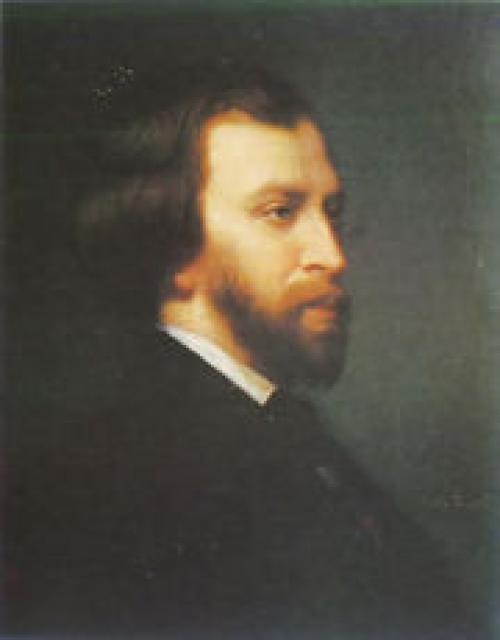
Louis Charles Musset
 France
- Alfred de Musset: A Romantic Poet, Playwright, and Novelist
- Literary Debut and Early Success
- Romantic Dramas and Comedies
- Poetic Outpourings
- Love and Heartbreak
- Autobiographical Writing
- Masterpieces of Romantic Theater
- Historical Drama and Literary Decline
Alfred de Musset: A Romantic Poet, Playwright, and Novelist
Early Life and EducationAlfred de Musset was born in Paris on December 11, 1810. He excelled in his studies at the Collège Henri IV and briefly pursued medicine, law, and art before embracing his true calling in literature.
Literary Debut and Early Success
Musset's talent became evident with his first collection of short stories, "Spanish and Italian Tales" (1829), which garnered critical and public acclaim. However, the failure of his play "The Venetian Night" (1830) discouraged him from writing comedies for the stage.
Romantic Dramas and Comedies
Musset's subsequent "Armchair Dramas" were written solely for reading. Among them, "The Cup and the Lips" is a quintessential Romantic drama featuring an unrestrained and unpredictable protagonist in an extravagant setting. "What Young Girls Dream Of" is a delightful and almost Shakespearean portrayal of youthful dreams and awakening love.
Poetic Outpourings
Seeking to expand his literary oeuvre, Musset included the Byronic-style poem "Namuna" in his "Armchair Dramas." His poem "Rolla" (1833), which tells the tragic tale of a young libertine who commits suicide, epitomizes the passionate and youthful style that characterized Musset's early work.
Love and Heartbreak
Musset's tumultuous love affair with George Sand, their whirlwind trip to Italy, and the inevitable breakup became a personal tragedy. He poured his anguish into poetry, resulting in the four-volume "Nights" (1835-1837) and the poignant "Souvenir" (1841).
Autobiographical Writing
Musset's autobiographical novel, "Confessions of a Child of the Century" (1836), captures the emotional climate of his affair with Sand, while "The Story of a White Blackbird" (1842) retells the same tale in fable form.
Masterpieces of Romantic Theater
During this period, Musset also penned several plays for reading that rank among the masterpieces of Romantic theater. "The Caprices of Marianne," "Fantasio," "No Trifling with Love," "Don't Promise Too Much," and "A Whim," among others, are elegant tragicomedies set in timeless and placeless worlds. They were later successfully adapted for stage by the Comédie-Française.
Historical Drama and Literary Decline
"Lorenzaccio" (1834), a full-scale historical drama, features a complex and Hamlet-like protagonist that remains one of Musset's most captivating creations. However, after 1841, Musset's literary output declined in quality, overshadowed by personal setbacks, ill health, and substance abuse. He was elected to the French Academy in 1852, but his later years were marked by despondency and decay. Alfred de Musset died in Paris on May 2, 1857.


