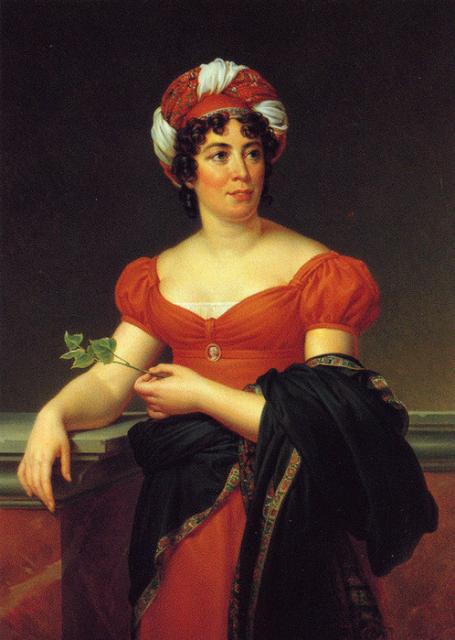
Louise Jermaine Stael-Holstein
 France
- Early Life and Education
- Marriage and Political Involvement
- Life in Coppet and Literary Works
- Persecution and Exile
- Later Years and Legacy
Biography of Anne Louise Germaine Necker, also known as Madame de Stael
Anne Louise Germaine Necker, known as Madame de Stael, was a French writer and publicist. She was one of the prominent figures at the origins of French Romanticism and modern literary criticism.
Early Life and Education
Anne Louise Germaine Necker was born into a Franco-Swiss Protestant family. Her father, Jacques Necker, was a banker who later became the Minister of Finance under Louis XVI. Her mother, Suzanne Curchod Necker, was a salon hostess who introduced Anne Louise to renowned thinkers such as Denis Diderot, Jean le Rond d'Alembert, Edward Gibbon, and Count de Buffon.
Marriage and Political Involvement
In 1786, Anne Louise married Baron Erik Magnus de Stael-Holstein, the Swedish Ambassador to France. However, their marriage ended soon after. During the French Revolution in 1789, her salon transformed into an influential political center. She supported her father's moderate liberal reforms. After her father's resignation in 1790, she aligned herself with the "Constitutionalists" party and later secured the appointment of her lover, Narbonne, as Minister of War in 1791. She helped him escape to England a few days before the September Massacres of 1792, and she followed him in early 1793.
Life in Coppet and Literary Works
In May of the same year, Anne Louise moved to her father's estate in Coppet, near Geneva, where she spent a significant part of her life. Her first notable work, "On the Influence of Passions on the Happiness of Individuals and Nations" (1796), was influenced by the terror of the French Revolution, during which she saved the lives of many of her friends. After Robespierre's downfall, she returned to Paris in 1795 with the political figure and publicist Benjamin Constant, with whom she had a turbulent relationship until 1810.
Persecution and Exile
Being consistently opposed to all political regimes in France, from the Directorate to the restored Bourbon monarchy, Stael faced several persecutions. In 1803, she was permanently expelled from Paris. Coppet, where she received prominent intellectuals and socio-political elites of her time, attracted those who shared her anti-Bonapartist sentiments. She traveled to Germany in 1803-1804, where she met Johann Wolfgang von Goethe, Friedrich Schiller, Johann Gottlieb Fichte, and leaders of the Romantic movement. She also traveled to Italy in 1805 and returned to France in 1806-1807 and 1810. Additionally, she visited Austria and Germany again in 1808. These journeys greatly influenced her two most famous books: the autobiographical novel "Corinne" (1808) and the treatise "On Germany" (1813).
Later Years and Legacy
Madame de Stael was able to return to Paris in 1814 after the fall of Napoleon. Her most significant work may have been "Considerations on the Principal Events of the French Revolution" (1816). Her interpretation of the events set the tone for subsequent liberal historians. Among her other works are the semi-autobiographical novel "Delphine" (1803) and the treatise "On Literature, Considered in Its Relation to Social Institutions" (1800), in which she attempted to interpret the intellectual revolution from a sociological perspective and formulate a new theory of progress.
Madame de Stael, the most prominent woman of her time, had a significant influence on her friends, including historians Auguste de Barante and Jean Charles Leonard Simonde de Sismondi, as well as the German critic, translator, and poet August Wilhelm Schlegel.