Lovis Corinth
 Netherlands
Biography of Lovis Corinth
German artist Lovis Corinth was one of the most prominent representatives of German Impressionism, along with Max Liebermann, Lesser Ury, and Max Slevogt. His later works are often considered a synthesis of Impressionism and Expressionism.
Early Life and Education
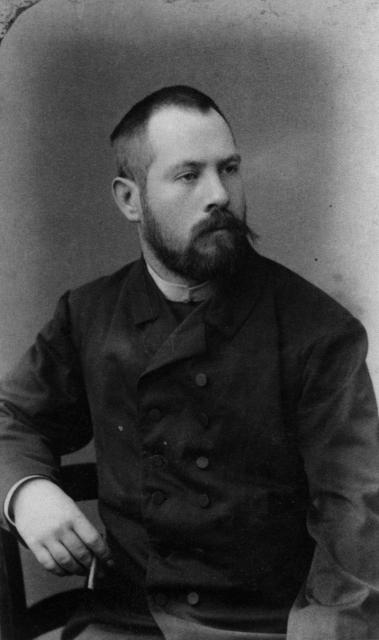
Lovis Corinth was born into the family of Heinrich and Wilhelmine Corinth, who owned a leather workshop and a large farm. He was their only child together and was raised with five half-siblings from his mother's previous marriage. From 1866 to 1873, Corinth attended the Kneiphof Gymnasium in Königsberg and lived with his aunt. During the Franco-Prussian War in 1870, soldiers stayed in his aunt's apartment. After his mother's death in 1873, Corinth returned to his family home, where he developed a desire to become an artist. In order to support his son's artistic education, Corinth's father sold their estate in Tapiau and moved with him to Königsberg. Corinth enrolled in the academy, where he was taught the basics of painting and historical painting by Otto Guenter. Along with Guenter and other students, Corinth traveled to Berlin and Thuringia, where he visited the workshops of Albert Brendel, Friedrich Preller, and Karl Buchholz. In his own work, Corinth focused on portraits and landscapes.
Career
Upon the recommendation of his teacher, Guenter, Corinth enrolled in the Academy of Fine Arts in Munich in 1880. At that time, the academy was considered one of the most renowned centers of painting, alongside the Parisian art scene. Corinth initially studied under Franz von Defregger, then under Ludwig von Loefftz, who had himself studied under Wilhelm von Diez. Alongside Corinth, the academy also had students such as Hans Olde and Bernhard Groenewold, with whom Corinth maintained friendly relationships even after completing his studies. Corinth joined the naturalistic movement, which sought to oppose classical historical painting. He also focused heavily on nude painting during his studies. Another influential teacher for Corinth was Wilhelm Trubner, upon whose death in 1920 Corinth wrote an obituary.
In 1882-1883, Corinth completed his military service and then traveled with his father to Italy and Lake Garda before returning to his studies. In the same year, his painting "The Conspiracy" received international recognition and was awarded a bronze medal at the London Salon. In Antwerp, Corinth also created one of his most famous works, "The Negro Othello," a portrait of a dark-skinned man. In October, Corinth traveled to Paris and enrolled in the private Julian Academy, where he gained experience working with the female nude. This period had a significant influence on his later work, especially his female portraits. Despite being in Paris at the same time as the famous Impressionists, such as Gustave Courbet and Edouard Manet, Corinth's work was more inspired by the exhibitions of Jean-Louis-Ernest Meissonier, Wilhelm Leibl, and particularly the retrospective of Jules Bastien-Lepage.
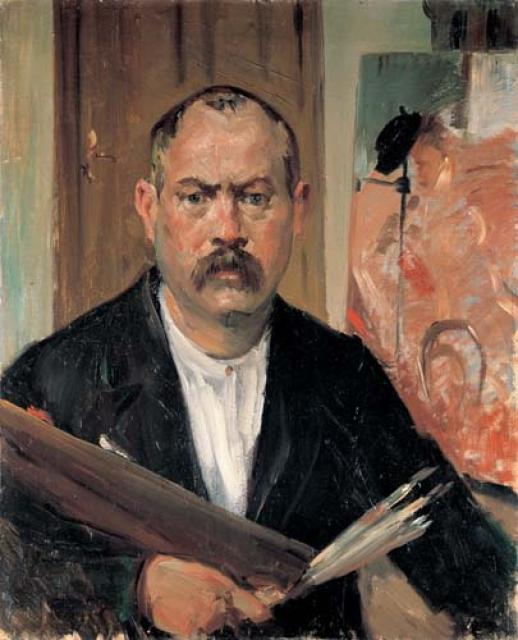
In the summer of 1886, Corinth and Hans Olde traveled to the Baltic Sea coast to paint landscapes and portraits. In 1887, he returned to Königsberg and painted a portrait of his father, which again was not well-received by the Königsberg Academy. In the same year, Lovis Corinth moved to Berlin and met artists such as Max Klinger, Walter Leistikow, and Carl Stauffer-Bern. It was likely in Berlin that Corinth painted his first self-portrait. The following year, Corinth returned home to Königsberg to be with his terminally ill father and painted several portraits until his father's death in January 1889. In 1890, his painting "Pietà" received an award at the Paris Salon. Encouraged by this success, Corinth considered moving to Munich again. He settled in Schwabing and captured the view from his apartment window in several of his paintings. Corinth became interested in plein air painting, which was popular among Munich's cultural figures such as Arnold Böcklin, Max Klinger, and Hans Thoma. Corinth's major work in this year was the large-format painting "Diogenes". However, the exhibition of his paintings at the Glass Palace did not meet expectations and instead faced intense criticism, causing Corinth to doubt himself once again. Corinth learned the art of etching from his friend Otto Eekman and, by 1894, he had created a series of etchings called "Tragicomedies," which showed the influence of Jugendstil and the work of Max Klinger.
Starting in 1892, Corinth created a series of paintings depicting scenes of slaughter, which made an impression on critics. These paintings were done in a realistic style on provocative subjects. Corinth was associated with the "revolutionaries" in the Munich art scene who did not exhibit their works in the official Glass Palace and instead met as part of the Munich artist community "Allotria." In 1892, this group split from Allotria to form the Munich Secession, which Corinth joined along with Max Liebermann, Otto Eekman, Thomas Theodor Heine, Hans Olde, Hans Thoma, Wilhelm Trubner, Franz von Stuck, and Fritz von Uhde. In 1893, Corinth, Eekman, Trubner, Heine, Max Slevogt, Karl Stratmann, Hermann Obriest, and Peter Berens attempted to create the "Free Association" to improve the exhibition situation. This led to disagreements within the Secession, and the association was not formed. The artists involved in the endeavor were subsequently excluded from the Secession. They held their own exhibitions in the Schulte Gallery.
Corinth's painting "Descent from the Cross" in 1895 was the first work that was truly sold. In the same year, it was presented at the exhibition in the Glass Palace and was awarded a gold medal. From 1895 to 1900, Corinth's works were displayed at exhibitions, but they did not make a significant impact on the public. Through one of his friends, Corinth became acquainted with members of the Munich literary circle "Die Nebenregierung," which included writers such as Max Halbe, Count Eduard von Keyserling, Frank Wedekind, and Otto Erich Hartleben. In 1896, Corinth became one of the co-founders of the Masonic Lodge "In Treue fest" (In Loyalty Firm), for which he painted the work "Brethren of the Lodge" in 1898, featuring twelve members of his lodge. In the following years, Corinth created some of his most successful and well-known works. Around 1896, he painted his famous "Self-Portrait with Skeleton." In 1897, he painted "The Temptations of St. Anthony" and "The Graces." In 1900, he painted "Salome," which he had high hopes for, but it was rejected from the Munich Secession exhibition. Disappointed by this failure, Corinth decided to leave Munich and move to Berlin. There, Leistikow, with whom he maintained a good relationship, along with Max Liebermann and Paul Cassirer, founded the Berlin Secession. In July 1900, "Salome" garnered significant attention at the second exhibition of the Berlin Secession, and Corinth became a prominent figure in Berlin. In addition to "Salome," his paintings "Susanna and the Two Elders" and "The Crucifixion" were also exhibited. Thanks to Leistikow, Corinth received his first portrait commissions. In the autumn of 1901, Lovis Corinth moved to Berlin and became a member of the Berlin Secession. In the same year, his painting "Perseus and Andromeda" was displayed at the Secession exhibition alongside works by Vincent van Gogh, Wilhelm Leibl, and Arnold Böcklin. Corinth also began teaching engraving at Otto Eekman's studio, and by 1894, he had created a series of etchings called "Tragicomedies," influenced by Jugendstil and the work of Max Klinger.
Later Life and Legacy
From 1919 to 1925, Corinth spent a lot of time in Nidden near Bad Doberan and created many drawings and paintings dedicated to Mecklenburg. In the spring of 1912, he vacationed with his wife on the Riviera, and in the summer, he painted "Blinded Samson." In December, Paul Cassirer was re-elected to the board of the Secession, and Corinth resigned, declining an offer to stay on the board and jury. In 1913, the first monograph about Lovis Corinth, written by Georg Biermann, was published. As an act of reconciliation with Corinth, Paul Cassirer organized a major retrospective exhibition of his works in the same year, opened by Max Liebermann. The exhibition featured 228 oil paintings by Corinth. Corinth's works were also exhibited at the "Great Düsseldorf Art Exhibition 1913" in Mannheim and the World Exhibition in Ghent, as well as various art galleries and museums in Baden-Baden, Munich, and Dresden. At the spring exhibition of the Berlin Secession, which celebrated its 15th anniversary in 1913, Corinth presented his paintings "Ariadne on Naxos" and "An Oriental Carpet Dealer." This exhibition and the autumn exhibition of the same year, which included works by Edvard Munch, Pablo Picasso, Ernst Ludwig Kirchner, and others, were highly successful. However, the successes of the Secession and Cassirer's exhibitions could not hide the internal conflicts. In the same year, serious accusations related to Cassirer's commercial activities in the art world were brought against him as a member of the Secession jury, leading to the departure of 42 artists, including Max Liebermann and the entire board. Lovis Corinth remained in the Secession, which was renamed the Free Secession, and he became the only artist with international fame.
In 1914, Corinth visited Monte Carlo and Rome, where he was particularly impressed by Raphael's frescoes in the Vatican. He then traveled to St. Moritz, but his trip was interrupted by the outbreak of World War I. Corinth was among the well-known artists, including Slevogt, Liebermann, and Ernst Barlach, who welcomed the start of the war.
In 1915, Corinth was re-elected as the chairman of the Berlin Secession and worked on an exhibition aimed at highlighting the traditional values of German painting. He provided several still lifes, portraits, and his painting "Joseph and Potiphar's Wife" for the exhibition.
In the following years, Corinth focused more and more on the war, which was reflected in his artwork. In 1917, he created "Cain" and "Portrait of Grand Admiral Alfred von Tirpitz." In the same year, writer Karl Schwarz published a book called "The Graphics of Lovis Corinth," providing a detailed account of Corinth's drawings and graphics. In August, Corinth visited Tapiau and presented several of his works to his hometown, which had awarded him the title of honorary citizen.
In March 1918, the Berlin Secession dedicated an exhibition to Lovis Corinth on the occasion of his 60th birthday, showcasing 140 of his oil paintings. Several of Corinth's works also participated in the spring exhibition of the Secession. During this time, the Berlin National Gallery began systematically collecting Corinth's works, which were displayed in the new art department of the Kronprinzenpalais after the war. The Berlin Academy of Fine Arts awarded him the title of professor. In 1919, Lovis Corinth acquired a villa in Zandvoort, Netherlands, as a summer residence.
In 1925, Lovis Corinth suffered a stroke, which resulted in partial paralysis. He continued to paint despite his disability but died later that year on July 17th. His legacy as an influential figure in German Impressionism and his contributions to the Berlin Secession continue to be recognized and celebrated today.