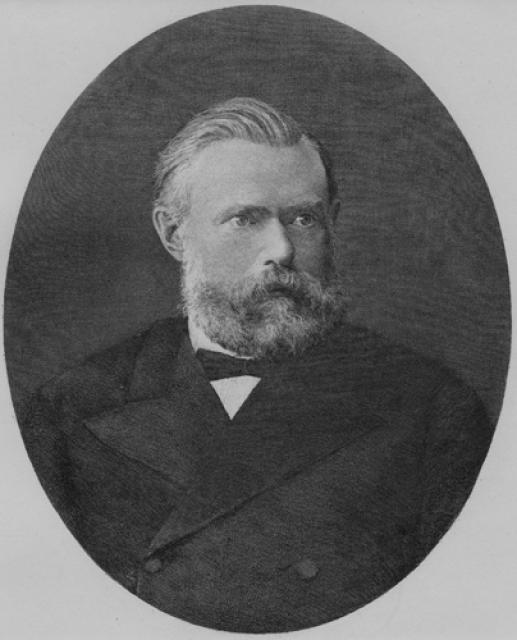
Ludvig Nobel
 Sweden
- Biography of Ludwig Nobel
- Early Life and Career
- Philanthropy and Later Life
- Ludwig Nobel passed away in March 1888.
Biography of Ludwig Nobel
Ludwig Nobel was a Swedish and Russian engineer, inventor, entrepreneur, and philanthropist. He was the older brother and business partner of the renowned founder of the Nobel Prizes, Alfred Nobel.
Early Life and Career
Ludwig worked at his father's machine-building factory in St. Petersburg. After his father and the entire family moved to Sweden, Ludwig continued to manage the "Nobel & Sons" factory for some time, at the request of creditors.
On October 1, 1862, Ludwig purchased Sherwood's mechanical workshop on the Vyborg side, which later became the Ludwig Nobel Machine-Building Factory. In addition to his entrepreneurial activities, he was involved in engineering and rational development of his products.
Ludwig manufactured artillery shells, cannons, torpedoes, and submarines (he was one of the leading experts in this type of ammunition). He also produced shields to protect infantry from bullet fire, rifles, metal processing and gunpowder production machines, screw piles, retorts for coal firing, hydraulic presses, lathe-drilling machines for cast iron cannons, steam hammers, and various machines.
He even pioneered the production of diesel engines in Russia. In the early 1880s, Ludwig, along with his brothers Robert and Alfred, and several others, established the "Nobel Brothers' Partnership," which quickly became one of the best companies in Russia and Europe for oil extraction, processing, and transportation (specifically, Baku oil). Their kerosene sales completely displaced the American company "Standard Oil" from the European market.
Ludwig also commissioned the construction of the first Russian oil pipeline in the Baku region. He was fluent in five languages: Swedish, Russian, English, French, and German.
Philanthropy and Later Life
In 1886, Ludwig initiated and founded the Russian Technical Society and played a key role in introducing the metric system of measurements in Russia, for which he provided the necessary funds. He also provided financial support for the Russian Academy of Sciences, the Russian Technical Society, and funded schools for railroad workers and laborers.
Ludwig Nobel passed away in March 1888.
LegacyAfter Ludwig Nobel's death, the "Nobel Brothers' Partnership" decided to establish a scholarship in his name for students at the St. Petersburg Mining and St. Petersburg Technological Institutes. In 1900, the International Congress in Paris established the Ludwig Nobel Gold Medal for research in the field of the oil extraction industry. The medal was minted at the St. Petersburg Mint.
The Russian Technical Society and the "Nobel Brothers' Partnership" also established a gold medal and award, given once every five years for research and development in the field of science and technology. Thus, shortly before the international Nobel Prizes were established using the funds and in honor of Alfred Nobel, Ludwig Nobel's brother and the inventor of dynamite, Russia had the Ludwig Nobel Prize.
Ludwig was survived by his first wife, Mina, who passed away in 1869, and his second wife, Edla Konstantinovna Nobel, who died in Stockholm in 1921. He had several sons, including Emmanuel, Karl, Ludwig, Rolf, Emil, Joost, and daughters Anna, Mina, Ingrid, and Martha (Nobel-Oleinikova).


