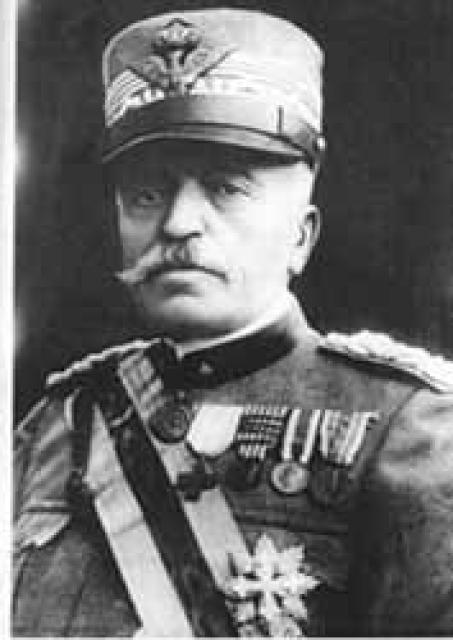
Luiggi Cadorna
 Italy
ItalyBiography of Luigi Cadorna
IntroductionLuigi Cadorna was an Italian military officer and statesman who served as the Chief of Staff of the Italian Army during World War I. He was born on September 4, 1850, in Pallanza, Italy.
Early Life and Education
Luigi Cadorna was the son of Italian General Raffaele Cadorna and the nephew of Count Carlo Cadorna, a prominent statesman. He received his education at the Military College in Milan in 1868 and later attended the Military Academy in Turin in 1875.
Military Career
Cadorna began his military career in the artillery regiment and later served in the infantry division in Florence. In 1883, he became the commander of the 62nd infantry regiment in Alba and eventually moved on to staff positions. He went on to command the 10th Bersaglieri Regiment in 1892 and later served as the Chief of Staff of the 8th Army Corps.
In 1898, Cadorna became the commander of the "Pistoia" Brigade and in 1905, he led a division in Ancona. From 1907 to 1909, he served in Naples and in 1910, he became the commander of the 4th Army Corps in Genoa. In 1911, Cadorna was appointed as the commander of the 2nd Army and a senator.
World War I
With the outbreak of World War I, Cadorna was named the Chief of Staff of the Supreme Command of the Italian Army. Under his command, Italy deployed an army of 22,800 officers, 843,000 soldiers, and a significant number of artillery pieces. The forces were organized into four armies led by General Raoul Brusati, General Pietro Frugoni, General Luigi Cukkari, and later Duke of Aosta, and General Luigi Nava. Cadorna's headquarters were in Udine.
However, Cadorna's leadership during the war was heavily criticized for his inability to maintain communication with his commanders and troops. The Supreme Command became disconnected from the field armies as a result. Despite his shortcomings, Cadorna led the Italian army in several offensives on the Isonzo Front, aiming to capture strategic positions. These offensives resulted in limited success, with the Austrians managing to hold their ground.
In 1917, the Italian army suffered a major defeat at the Battle of Caporetto, where the 14th German Army broke through the Italian lines. This led to a chaotic retreat of all Italian armies, which was only halted with the assistance of Anglo-French divisions. As a consequence of the defeat, Cadorna was dismissed from his position as Chief of Staff and appointed as a member of the Supreme War Council in Versailles, France.
Later Life and Legacy
After his dismissal, Cadorna retired from active service in September 1918. Following the rise of Benito Mussolini to power in 1922, Cadorna returned to military service. He wrote memoirs detailing his experiences during World War I and passed away on December 21, 1928, in Bordighera, Italy. Despite the mixed evaluation of his leadership during the war, Cadorna's contributions to the Italian military continue to be studied and debated among historians.