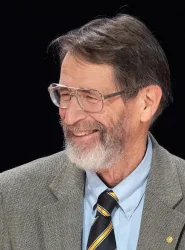
M. Stanley Whittingham
- Childhood and Education
- The Battery Breakthrough at Exxon
- Return to Academia
- Nobel Prize and Recognition
- Later Work and Legacy
A chemistry problem that began in the laboratory would eventually help power phones, laptops, and electric cars. M. Stanley Whittingham was one of the researchers who opened the way to rechargeable lithium batteries, developing an early system based on the movement of lithium ions between electrode materials. His work, pursued first in industry and later in academia, earned him a share of the 2019 Nobel Prize in Chemistry.
Childhood and Education
Whittingham was born in Nottingham, England, on December 22, 1941. He attended Stamford School in Lincolnshire before studying chemistry at New College, Oxford. He earned his bachelor’s degree in 1964 and completed a doctorate in inorganic chemistry in 1968, working with chemist Peter Dickens.
After Oxford, Whittingham crossed the Atlantic for a research position at Stanford University. There he worked in materials science and engineering, building expertise in the solid-state chemistry that would become central to his battery research.
The Battery Breakthrough at Exxon
In 1972, Whittingham joined Exxon Research and Engineering Company. At a time when oil companies were exploring energy technologies beyond petroleum, he investigated how lithium could move into and out of layered materials. This process, known as intercalation, became the key idea in his rechargeable battery work.
Whittingham’s early battery used lithium metal as one electrode and titanium disulfide as the other. Lithium ions could move between the materials during charging and discharging, allowing the cell to be recharged. The system demonstrated the promise of high-energy rechargeable batteries, though safety challenges associated with lithium metal limited its practical use. Exxon developed the technology toward commercial applications, but the company later ended the project as its priorities changed.
Whittingham continued in industry, including work at Schlumberger-Doll Research, before returning to university life. His early experiments did not by themselves produce the lithium-ion batteries familiar today, but they established an important foundation: rechargeable cells could be built around lithium’s movement between host materials.
Return to Academia
In 1988, Whittingham joined Binghamton University in New York, where he helped develop programs in materials chemistry and materials science and engineering. His research has focused on the chemistry and structure of materials that can store and release ions, as well as the mechanisms that limit the performance of batteries.
At Binghamton, he became a distinguished professor and led research initiatives devoted to energy storage. He has also taken part in broader efforts to expand battery research, manufacturing, and supply chains in the United States. The work connects fundamental chemistry with a practical challenge: making batteries more capable, durable, and useful for energy storage and transportation.
Nobel Prize and Recognition
In 2019, Whittingham shared the Nobel Prize in Chemistry with John B. Goodenough and Akira Yoshino. The Nobel committee recognized the trio for their contributions to the development of lithium-ion batteries. Whittingham’s role was the early demonstration of the potential of lithium-based intercalation electrodes; Goodenough’s later materials research and Yoshino’s subsequent battery design helped move the technology toward safer, commercially viable cells.
The award brought renewed attention to a research path that had unfolded over several decades. Rechargeable lithium-ion batteries became central to portable electronics and electric vehicles, while also attracting growing interest for storing renewable energy. Whittingham has continued to discuss the need for further improvements in battery materials and manufacturing, rather than presenting the technology as a finished solution.
Later Work and Legacy
Whittingham remains associated with Binghamton University, where he has continued to work on energy storage and battery research. His career has moved between corporate laboratories and universities, but the central question has stayed consistent: how can the structure and chemistry of materials be used to store energy efficiently?
His place in battery history rests on both discovery and persistence. The first system he developed faced limitations, and the lithium-ion cell matured through the contributions of many scientists and engineers. Yet the intercalation approach he helped establish became a cornerstone of rechargeable battery technology, connecting fundamental solid-state chemistry to devices used around the world.