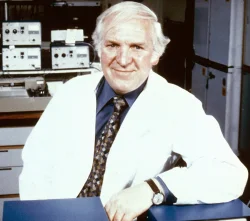
Jean-Pierre Sauvage
Jean-Pierre Sauvage helped turn the idea of a machine built from molecules into working chemistry. A French coordination chemist, he developed a way to link ring-shaped molecules mechanically, creating structures whose parts could move in controlled ways. That achievement became a foundation for the field of molecular machines and earned him the 2016 Nobel Prize in Chemistry.
Education and early research
Born in Paris in 1944, Sauvage studied chemistry at the École Nationale Supérieure de Chimie de Strasbourg. He continued at the University of Strasbourg, where he completed his doctorate in 1971 under Jean-Marie Lehn, later a Nobel laureate himself. Sauvage’s doctoral work focused on cryptands and cryptates, molecular structures capable of binding ions. The research introduced him to the intricate design of molecules that can recognize and organize other chemical components.
After a period of postdoctoral research with Malcolm Green at the University of Oxford in 1973–1974, Sauvage returned to France and pursued a career at the National Centre for Scientific Research (CNRS). He built his research life in Strasbourg, working with teams of chemists on increasingly ambitious synthetic structures.
The catenane breakthrough
In 1983, Sauvage and his colleague Christiane Dietrich-Buchecker achieved a landmark in molecular construction: a high-yielding, template-directed synthesis of a catenane. A catenane consists of two or more molecular rings interlocked like links in a chain. The rings are not joined by an ordinary chemical bond; their connection is mechanical, so they can retain a degree of freedom to move against one another.
The strategy used a copper ion to help bring molecular components into the right arrangement before the structure was completed. This transformed interlocking rings from a striking but difficult chemical curiosity into a design that could be made and studied systematically. The advance opened the door to molecular switches and other systems in which a stimulus could prompt one part of a molecule to move relative to another.
From that early achievement, Sauvage’s group explored more elaborate molecular architectures, including structures with controlled movement and molecular systems compared to muscles or compressors. The point was not simply to make molecules look like familiar machines: it was to build chemical devices whose components could perform a defined movement in response to an input.
Recognition and later career
Sauvage served as a professor at the University of Strasbourg and held senior research roles at CNRS. He became professor emeritus at Strasbourg and research director emeritus at CNRS. His work drew recognition from the international chemistry community well before the Nobel announcement, including the CNRS Gold Medal in 2001.
In 2016, the Nobel Prize in Chemistry was awarded jointly to Sauvage, Sir J. Fraser Stoddart, and Bernard “Ben” Feringa “for the design and synthesis of molecular machines.” The prize recognized complementary advances: Sauvage’s interlocked molecular systems, Stoddart’s mechanically interlocked structures, and Feringa’s molecular motors. Their work gave researchers a new way to think about motion at the smallest scale, where ordinary mechanical intuition no longer applies.
Legacy
Sauvage’s contribution lies in making molecular motion a matter of deliberate design. By showing how chemical components could be assembled into mechanically linked structures, he helped establish a toolkit for chemists exploring machines far smaller than a cell. The field remains a meeting point of chemistry, physics, and materials science, with possible applications still under investigation. His career also reflects the collaborative nature of discovery: the catenane breakthrough emerged from a research team and became a platform on which scientists around the world could build.