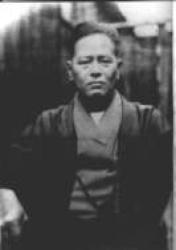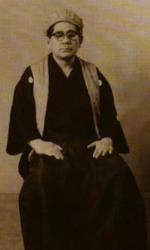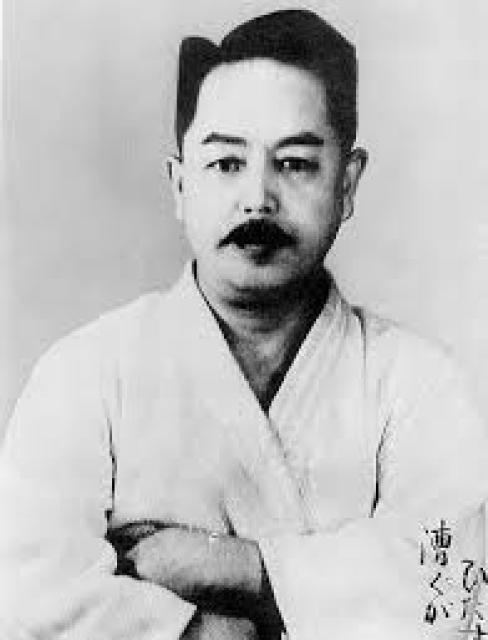
Mabuvi Kenwa
 Japan
Japan- The Founder of Shito-ryu Karate
- Early Life and Training
- Police Service and Martial Arts Exploration
- The Rise of Karate and Mabuni's Teaching
- The Birth of Shito-ryu and the Okinawa Karate Club
- The Influence of Kano Jigoro and the Move to Osaka
- Challenges and Triumphs in Osaka
- Post-World War II and the Legacy of Shito-ryu
The Founder of Shito-ryu Karate
Kenwa Mabuni, the founder of the Shito-ryu style of karate, was born on November 14, 1889, in the city of Shuri on the Okinawan archipelago. He was the 17th-generation descendant of one of Okinawa's most renowned clans, founded by Keniio Osho, the legendary warrior of the Ryukyu Kingdom.
Early Life and Training
Despite having frail health as a child, Mabuni was inspired by tales of his illustrious warrior ancestors to pursue a path of strength and honor. At the age of 13, he was accepted into the school of the renowned karate master Itosu in Shuri. Mabuni trained relentlessly, attending every session even during typhoons, and spent seven years studying the art of Shuri-te. At the age of 20, Mabuni began studying the Naha-te style under Master Kanryo Higashionna. These two major Okinawan karate lineages would later form the foundation of Mabuni's Shito-ryu style.
Police Service and Martial Arts Exploration
After graduating from high school and serving in the army, Mabuni worked in the police force for approximately 10 years. During this time, he became proficient in judo and kendo, which were part of the mandatory training program for police officers. As a karate master, Mabuni sought to combine the strengths of different martial arts into a versatile fighting system. His work in the police afforded him the opportunity to study other karate styles and meet lesser-known masters throughout the island. He also devoted considerable attention to the ancient art of Reikan Budo.
The Rise of Karate and Mabuni's Teaching
The early 20th century witnessed a surge in the popularity of karate. In 1910, it was officially recognized and included in the curriculum of prefectural high schools as a separate discipline. However, there was a lack of standardized teaching methods and criteria for grading. During this period, many masters emphasized physical conditioning and the toughening of striking surfaces through exercises such as makiwara training.
Mabuni began teaching karate during this time. Together with his mentor, Itosu, he established a karate club for dedicated students. In 1918, his eldest son, Ken'ei, was born. The same year, Mabuni intensified his efforts to promote karate, collaborating with renowned masters such as Gichin Funakoshi, Tezu Oshito, Toshin Chibana, Anbun Tokuda, Shinnan Zema, Seito Tokumura, and Hoko Ishikawa.
The Birth of Shito-ryu and the Okinawa Karate Club
In 1924, Mabuni became a karate instructor at two educational institutions and was honored to demonstrate his art before Prince Chichibu. In 1925, he joined forces with other masters to establish the "Okinawa Karate-do Club," fulfilling his long-held dream of creating a permanent dojo for training. The club attracted legendary karate figures such as Juhatsu Keda, Teijun Miyagi, Teiu Motobu, Toshin Chibana, Hanashiro, Teju Oshito, and Woo Xiang Tui, a kempō master. Mabuni and Miyagi became the club's permanent instructors.
Training sessions at the club focused on physical conditioning and kumite practice. Techniques were not explained to students but demonstrated directly during free sparring. Repetition and practice were the primary means of learning. Each master's technique had its own unique characteristics.
The Influence of Kano Jigoro and the Move to Osaka
The year 1927 proved to be pivotal in Mabuni's life. He met Jigoro Kano, the founder of modern judo, who had come to Okinawa to open a judo dojo. Miyagi and Mabuni demonstrated and explained karate techniques to Kano, who highly praised it as a martial art that combined both defense and offense. He encouraged its widespread dissemination on a national scale.
Inspired by Kano's endorsement, Mabuni decided to move to Osaka and dedicate himself to the development and propagation of Shito-ryu karate in mainland Japan.
Challenges and Triumphs in Osaka
Initially, Mabuni faced significant challenges in Osaka due to misunderstandings and misinterpretations of karate. He gave demonstrations at police stations, universities, and even Buddhist temples to raise awareness of the art. Kata, in particular, proved difficult for the general audience to grasp, and it was often dismissed as "fist dancing." In order to attract attention, Mabuni had to resort to demonstrations of temakashiwari, breaking bricks and boards to showcase the power of his new fighting style.
Despite these hurdles, Mabuni remained steadfast in his mission. His tireless efforts bore fruit in 1931 with the establishment of the "Dai-Nihon Karate-do Kai," later renamed "Nihon Karate-do Kai," the forerunner of the present-day Shitokai. Many of the founders of the Dai-Nihon Karate-do Kai were Mabuni's students, and they now form the core of the Shitokai within the Japan Karate-do Federation, continuing to pass on Mabuni's martial art.
Post-World War II and the Legacy of Shito-ryu
After World War II, karate clubs began to revive in colleges and universities. Intercollegiate matches and national championships were held. Despite the harsh economic conditions in post-war Japan, Mabuni continued to dedicate himself to spreading Shito-ryu karate, believing that it could help in the nation's recovery. He passed away on May 23, 1952, leaving behind a legacy that continues to inspire countless martial artists around the world.