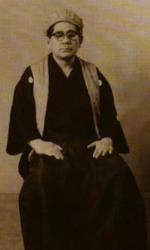
Miyagy Tedzyun
 China
ChinaBiography of Miyagi Chojun
Miyagi Chojun was a renowned Okinawan martial artist and the founder of the Goju-Ryu Karate-Do style. He began studying karate at the age of 14 on Okinawa and trained under one of the most famous masters of the time, Kanryo Higashionna, the founder of the Naha-Te style. After thirteen years of training, Miyagi traveled to China, where he studied the Chinese martial arts of Tugoku Kembo in the Fukien province of Fuzhou for several years until 1917.
Upon returning to Okinawa, Miyagi became an instructor at the police training center, as well as at the city commercial school, the recreation and health center, and other organizations. In 1928, he arrived in Japan and began teaching karate at the Imperial University in Kyoto, followed by the Kansai University and the Ritsumeikan University in Kyoto. In 1930, he became the president of the Okinawa Ken Taiiki Kyokai Karate-Do, the athletics association of Okinawa Prefecture's karate division.
Miyagi played a significant role in the official recognition of karate as a martial art in Japan. Due to his efforts, the art was formally established in the Butokukai in 1933. He was invited to give lectures and conduct practical training in Hawaii by Tinei Kinjo, the publisher of the "Yosen Fihyo Sha" newspaper in Okinawa, in May 1934.
In January 1936, Miyagi delivered a lecture at the Sakaisudzi Meiji Shoten in Japan titled "Reflections on Karate-Do," in which he emphasized the importance of relaxation in karate and the principle of "Kenzan Itchi" (the unity of Zen and the hand). He also advocated for the openness and sharing of karate with the world.
In the same year, Miyagi was awarded the Medal for Outstanding Achievements in Martial Arts by the Japanese Ministry of Education. He traveled to China in 1936 to study Chinese martial arts in Shanghai. In May 1937, he was entrusted by Prince Morivasa Nasimoto, a designated member of the Dai Nippon Butokukai, to form the Dai Nippon Butokukai Karate Jukkukai (Association of Karate and Martial Arts Instructors of Japan) with the main instructors of two schools of Dzu-Djutzu (Shinto-Shizen-Ryu and Kyushin-Ryu) to oversee and coordinate karate activities nationwide.
Miyagi's contributions to the development and dissemination of karate as both a self-defense art and a spiritual discipline were significant. He analyzed the Naha-Te art, the legacy of Higashionna, and formulated the theoretical basis for the practice of karate-do. He developed the Tencho kata, combining hard and soft circular hand movements, and created a series of body conditioning exercises to prepare for advanced kata (Kaisu).
Miyagi named his school "Goju" (hard and soft) after a phrase he borrowed from the ancient Chinese book "U Bei Jin" (Military Calculations and Martial Arts), which states that successful combat methods involve both giving and taking. He emphasized the principle of "Nanji Kyokuden," which means using all one's strength without reservation in any endeavor, as victory is not the ultimate goal, and defeat is not the end.
Miyagi's successor in the Goju-Ryu style was his student Meitoku Yagi, who received the title of Great Master in 1936 and continued to carry on Miyagi's teachings. Miyagi passed away on October 8, 1953, due to a heart attack.